
Composting toilets don’t just “hide” waste the way a chemical cassette does — they rely on the same aerobic decomposition process as a backyard compost pile, just scaled down, sped up where possible, and managed more carefully because there’s a lot less room for error in a small chamber than in an open-air bin. Here’s what’s actually happening inside one, step by step.
Step 1: Urine Diversion
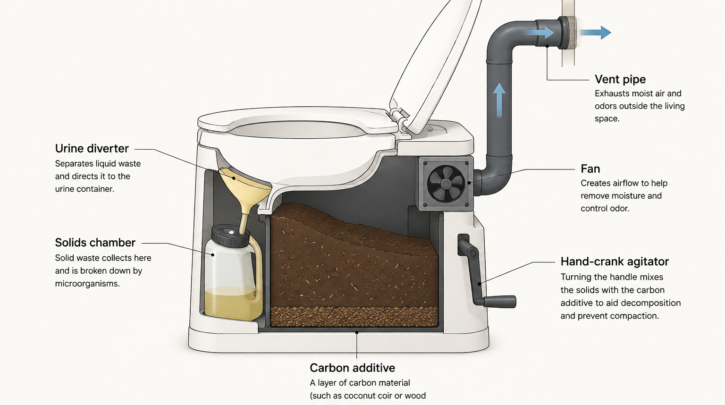
In most modern units, a front section of the bowl or a diverter insert routes liquid waste into a separate container before it ever reaches the solids chamber. This single step does more to prevent odor than anything else in the system, because it keeps the solids chamber dry enough for aerobic bacteria to actually thrive rather than getting overwhelmed by excess moisture. Urine itself is largely sterile when it leaves the body, but once it mixes with fecal solids it creates the conditions for the bacterial process that produces a genuinely unpleasant smell — which is exactly what diversion is designed to prevent from ever starting.
Step 2: Carbon Additive
Before or after use, a scoop of carbon-rich material — sawdust, coco coir, or peat moss are the most common choices — goes into the solids chamber. This material does three distinct jobs at once, and understanding all three helps explain why skimping on it causes problems:
- Absorbs residual moisture that even a good urine-diversion system doesn’t fully eliminate
- Balances the carbon-to-nitrogen ratio bacteria need to break material down efficiently — waste alone is nitrogen-heavy, and bacteria need roughly balanced carbon input to process it well
- Adds air pockets that keep the mix aerobic instead of compacting into an airless, anaerobic mass — this is a purely physical/structural function separate from its chemical role
We compare the three main options in detail, including cost per use and moisture-holding capacity, in sawdust vs. coco coir vs. peat moss.
Step 3: Aerobic Decomposition
Aerobic bacteria — the same broad category at work in any backyard compost bin — break down organic solid waste into a stable, soil-like material. This process needs oxygen, which is why moisture control and occasional mixing or agitation matter so much; many units include a hand-crank or electric agitator specifically for this purpose. Too wet, and the bacteria that thrive shift toward anaerobic species instead — the ones responsible for the classic “outhouse” smell most people associate with poorly maintained pit toilets rather than a properly functioning composting system.
Temperature plays a role too. Aerobic bacterial activity slows meaningfully below roughly 55°F (13°C), which is worth knowing if you’re running a unit through a cold winter — the toilet will still function as a waste-separation and holding system, but the actual breakdown into finished compost happens more slowly until temperatures rise again.
Step 4: Ventilation
A vent pipe, usually paired with a small fan, pulls air out of the solids chamber and exhausts it outside the living space — through a roof or wall vent in a van, cabin, or RV. This does two things at once: it supplies the oxygen aerobic bacteria need to keep working efficiently, and it creates negative pressure inside the unit so any odor is actively pulled out and away rather than drifting into the room on its own. See our venting and ventilation guide for van-specific hose diameters, fan specs, and routing rules by brand.
Step 5: Emptying
Depending on the unit and how many people are using it, solids get emptied every few weeks into a compost pile, a designated burial location, or in some cases general trash, depending entirely on local regulation. Urine gets emptied far more often — typically every 1–3 days — since liquid containers are smaller and fill faster than the solids chamber. Full schedule, step-by-step process, and troubleshooting live in our maintenance and emptying guide.
What Determines Whether It Smells
Every genuine odor complaint we’ve come across traces back to a breakdown in one of the steps above, not to some inherent flaw in the category of product itself:
- Urine mixing into solids — the diverter is clogged, misaligned, or the unit simply isn’t a urine-diverting design at all
- Insufficient carbon additive — not enough material added to absorb moisture and maintain airflow between uses
- Poor or blocked ventilation — fan failure, a kinked vent hose, or a vent that terminates somewhere air can simply flow back in
- Overfull solids chamber — not enough headspace left for air to circulate properly through the mix
Full troubleshooting steps, including a quick-reference table matching specific smells to specific causes, live in our odor guide.
Batch vs. Continuous Composting
Self-contained units are almost always “continuous” systems — the same chamber fills, gets partially composted along the way, and is emptied on a rolling basis before the process ever fully finishes inside the unit. Larger fixed installations sometimes use a two-chamber batch system instead: one chamber fills while a second one, already full, is left completely untouched to finish composting, then the two swap roles once the active chamber fills up. Batch systems produce a more finished, ready-to-use end product because they get uninterrupted time to break down, but they need meaningfully more physical space to house two full chambers side by side — which is exactly why you see them in cabin and off-grid home installations far more often than in vans.
Common Myths About How These Work
A few misconceptions come up often enough that they’re worth addressing directly. The first is that “composting” happens instantly, or even within days — it doesn’t. What’s happening inside the unit during normal use is closer to pre-processing than finished composting: the material is being kept aerobic and prevented from becoming sewage, but the full breakdown into a stable, soil-like end product takes months, usually in a secondary bin outside the unit entirely.
The second myth is that more carbon additive is always better. It isn’t — beyond a certain point, excess dry material doesn’t meaningfully improve odor control and just fills the chamber faster, requiring more frequent emptying for no real benefit. The right amount is enough to visibly cover fresh waste after each solid use, not a deep, wasteful layer.
The third is that all composting toilets work identically. They don’t — the difference between a hand-crank self-contained unit, an electric-agitator unit, and a urine-diverting design with an external drain line is significant enough that experience with one doesn’t fully transfer to the others, particularly around emptying routine and failure modes.
What Happens If You Skip a Step for Too Long
It’s useful to know not just what each step does, but what actually happens if you neglect it, since that’s usually how new owners learn the hard way. Skip carbon additive for a few uses in a row, and you’ll typically notice a shift toward a sourer, more sulfurous smell within a day or two as anaerobic bacteria start to gain ground in the wetter conditions. Ignore a full solids chamber past its rated capacity, and the mixture compacts to the point that the agitator becomes difficult or impossible to turn, sometimes requiring a partial manual excavation to free it back up. Let a fan fail without noticing for more than a few days, and odor that would otherwise be imperceptible starts to build gradually, especially in warmer weather when bacterial activity — both aerobic and anaerobic — runs faster. None of these are catastrophic or expensive to fix, but they’re all meaningfully easier to prevent than to reverse once they’ve set in.
How the Steps Interact With Each Other
It’s worth understanding that these five steps aren’t independent — a weakness in one tends to show up as extra strain on the others. A slightly underpowered fan, for instance, isn’t just a ventilation problem in isolation; it also means moisture takes longer to leave the chamber, which puts more of the workload on carbon additive to keep things dry enough for aerobic bacteria to function. Similarly, a urine diverter that’s imperfectly sealed doesn’t need to fail completely to cause problems — even a small, consistent trickle of urine into the solids side will gradually push the chamber’s moisture balance in the wrong direction over days or weeks, long before it’s obvious enough to diagnose as “the diverter is broken.”
This is also why troubleshooting an odor issue works best as a process of elimination through each step in order, rather than guessing at a single cause. A unit that’s using plenty of carbon additive but still developing an odor is more likely to have a ventilation or diversion problem than a “not enough additive” problem — the additive is doing its job; something upstream of it is overwhelming that job with more moisture than it can reasonably absorb.
Frequently Asked Questions
Does a composting toilet actually finish composting inside the unit?
Partially. Most manufacturers recommend a secondary composting period outside the unit — in a dedicated outdoor bin — before the material is fully broken down and safe to use as a soil amendment. See our using composting toilet output as fertilizer guide for the specific safety guidance around this.
How long does the composting process take?
Full breakdown to a soil-like state typically takes several months under ideal conditions, which is exactly why most self-contained units are really “waste management and pre-processing” tools first — the actual finished composting happens later, elsewhere.
Do they work in cold weather?
Aerobic bacterial activity slows significantly below roughly 55°F (13°C), which affects breakdown speed but not the toilet’s basic function as a waste-diversion and holding system — it will still separate and hold waste normally through cold months, just with slower composting until temperatures come back up.
Why do some units have a hand crank and others don’t?
The crank (or, on some newer models, a push-button electric agitator) mixes the solids chamber to keep air pockets from collapsing and to distribute carbon additive evenly through the mix. Not every design uses one — some rely on a bag-and-layer method instead, trading some composting efficiency for a simpler, no-moving-parts mechanism.