

If your composting toilet smells, something specific is off — it’s not just “how they are.” Every genuine odor complaint we’ve come across traces back to one of five fixable causes, and in nearly every case, the fix takes minutes once you know which cause you’re actually dealing with. This guide walks through diagnosis first, then fixes, then how to prevent the same issue from coming back.
Quick Diagnosis
| What it smells like | Likely cause |
|---|---|
| Ammonia / sharp, sour | Urine sitting too long, or urine mixing into solids |
| Classic “outhouse” / sulfurous | Anaerobic conditions — mixture is too wet, not enough carbon additive |
| Musty, damp | Ventilation isn’t running or is blocked |
| Faint smell only right after use | Normal — should clear within seconds if venting works |
| Smell near the vent exterior only | Vent termination point is too close to a window, door, or air intake |
Work through this table before doing anything else. Most people’s instinct when they smell something is to reach for an air freshener or deep-clean the whole unit, when the actual fix is usually much narrower and faster than that instinct suggests.
Cause 1: Urine Mixing Into Solids
This is, by a wide margin, the most common cause of real odor problems, and it’s worth understanding why it matters so much: urine mixed into the solids chamber saturates the mix and shifts the bacterial balance from aerobic to anaerobic, which is the actual biological process behind the smell people associate with poorly maintained pit toilets. Check that:
- The urine diverter or trap door is seated correctly and not cracked or warped
- You — and anyone else using the toilet — are using it correctly; most urine-diversion failures come from user positioning rather than hardware failure, and this disproportionately affects smaller-framed users who need to sit slightly further forward than they might on a standard flush toilet
- The diverter isn’t clogged with toilet paper or mineral buildup, which can happen gradually over months of use without being obvious at a glance
Cause 2: Not Enough Carbon Additive
Carbon additive — sawdust, coco coir, or peat moss — absorbs moisture and creates air pockets aerobic bacteria need to keep functioning efficiently. If you’re skimping to stretch a bag further between resupply runs, you’re trading a few dollars of savings for a real and fairly likely odor risk down the line. Add a generous scoop after every solid use, not just occasionally when you remember. See our sawdust vs. coco coir vs. peat moss comparison if you’re not sure which material fits your climate and usage pattern best — humid climates in particular benefit from a material with stronger moisture-holding capacity.
Cause 3: Ventilation Failure
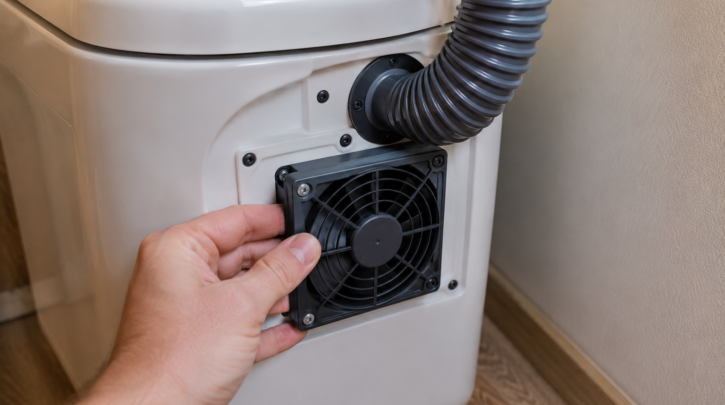
Ventilation does two jobs at once inside a composting toilet: it supplies the oxygen the aerobic breakdown process needs, and it creates negative pressure that actively pulls odor outside rather than letting it drift into the cabin on its own. When it fails, both of those benefits disappear simultaneously, which is why a ventilation problem tends to produce a noticeably faster and more obvious odor onset than the other causes on this list. Check, in order:
- Is the fan actually running? Hold a piece of tissue near the vent outlet — it should visibly pull toward the vent if airflow is working.
- Is the vent hose kinked or crushed? Common after a build has settled or after storage compartments shift during travel.
- Is the exterior vent blocked? Debris, insect nests, and snow are common culprits, and they build up gradually enough to go unnoticed until airflow is already significantly reduced.
- Is the fan actually failing? Most units use an inexpensive 12V computer-style fan that’s simple to test with a multimeter and replace without specialized tools.
Full setup details, including hose diameter and fan specs by brand, are in our van venting and ventilation guide.
Cause 4: Overfull Solids Chamber
An overfull chamber leaves no headspace for air to circulate, which starves the aerobic process regardless of how well your ventilation and carbon additive are otherwise performing. If your crank feels stuck or the level is visibly near the top, empty it now — don’t wait for your usual schedule, since an overfull chamber tends to get progressively harder to service the longer it’s left, not easier.
Cause 5: Poor Vent Placement
Even a perfectly functioning vent can create a perceived odor problem if it terminates too close to a window, door, awning, or air intake. On vans and RVs specifically, this is easy to overlook during a build, since the shortest possible hose run often points toward exactly the kind of nearby opening you want to avoid. Reroute the termination point a few feet away from anywhere air re-enters the living space, even if it means a slightly longer hose run than the minimum.
How Long a Fix Actually Takes to Work
Once you’ve identified and corrected the cause, it’s worth knowing how quickly you should expect improvement, since expecting instant results can lead people to conclude a fix “didn’t work” when it just needs a bit more time. Correcting a ventilation problem — replacing a fan, clearing a blocked vent — typically resolves odor within hours, since it’s addressing the symptom directly. Correcting a moisture problem by adding carbon additive usually takes a day or two to show clear improvement, since the existing wet material needs time to dry out even with better absorption going forward. If you’ve just emptied an overfull chamber, expect near-immediate improvement, though the smell of fresh material settling in can take a few uses to fully normalize.
Prevention Checklist
- Add carbon additive after every solid use, not just when you remember
- Empty the liquids container on a fixed schedule rather than waiting until it’s visibly full
- Check fan operation weekly, even briefly
- Never let the solids chamber go more than a week or two past its rated capacity
- Clean gaskets and seals every few months — a failed seal is a sneaky, often hard-to-diagnose odor source that tends to get blamed on other causes first
When It’s Not the Toilet
Occasionally an odor that seems to come from the toilet is actually coming from a nearby greywater line, an old urine spill that soaked into flooring or subfloor material months earlier, or a P-trap-less drain elsewhere in the space entirely. If you’ve worked through every cause above and still have a problem, it’s worth checking those sources before assuming the toilet itself is at fault — we’ve seen more than one case where a persistent “toilet smell” turned out to be an unrelated drain issue a few feet away.
Odor Differences Between Designs
Not every composting toilet design has the same odor risk profile, and it’s worth understanding this before assuming all five causes above apply equally to your specific unit. Urine-diverting designs with an external drain line — like the Separett Villa — remove one entire failure mode, since there’s no onboard urine container that can leak or overflow into the solids side. Electric-agitator designs, by contrast, introduce a different risk: if the motor fails, mixing stops happening even though the rest of the system is fine, which can gradually push the chamber toward the wet, compacted conditions that cause odor even without any diversion failure at all. Bag-based designs without an agitator sidestep the mixing question entirely but rely more heavily on frequent bag changes to prevent buildup, since there’s no ongoing mixing to redistribute moisture within a single bag’s contents.
None of this means one design is universally better at odor control than another — it means the specific failure mode you should be watching for differs by design, and it’s worth knowing which one applies to your unit rather than troubleshooting generically.
A Note on Smell Sensitivity
People genuinely vary in how sensitive they are to the specific compounds involved here, and it’s not unusual for one person in a shared space to notice something the other doesn’t at all. This isn’t a sign anything is wrong with either person’s sense of smell — it’s a well-documented variation in olfactory sensitivity to specific compounds, and it means a “no smell at all” report from one owner doesn’t guarantee the same experience for everyone using the same unit. If you’re more sensitive than average, it’s worth being somewhat more proactive about the prevention checklist below rather than waiting for a smell you might notice later than most people would.
Related Guides
Frequently Asked Questions
Is it normal to smell anything at all?
A brief, faint smell for a few seconds right after solids use is normal and should clear on its own as the fan pulls air through the chamber. Anything lingering longer than that points to one of the five causes above.
Can I use an air freshener or odor spray as a workaround?
You can, but it masks rather than fixes the underlying problem, and some fragrance products can interfere with the aerobic bacteria doing the actual work in the solids chamber. Diagnose the root cause first, and treat a spray as a short-term measure at most.
Does a new composting toilet smell different when first set up?
A very slight “new plastic” smell is normal for the first few uses and isn’t related to waste odor at all — it fades quickly as the unit airs out during normal operation.
Will guests notice a smell even if I don’t?
It’s possible to become desensitized to a mild, ongoing smell in your own space that a first-time visitor would notice immediately. If you’re hosting guests and want a sanity check, ask someone to use the bathroom and give you honest feedback rather than assuming your own nose is a reliable gauge after months of daily exposure.