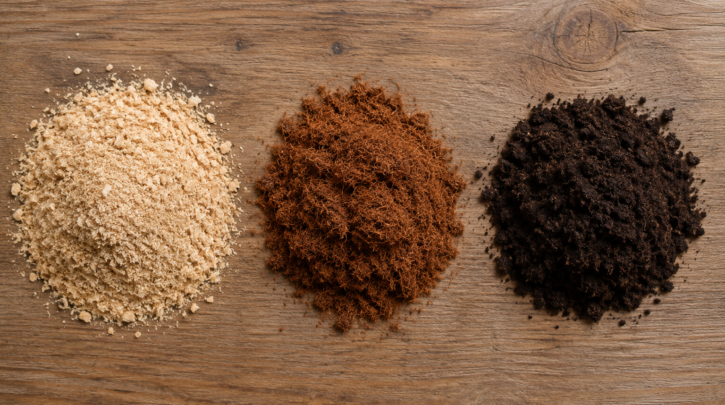

Your choice of carbon additive affects odor control, how often you empty the chamber, and — for electric-agitator units specifically — whether the mechanism itself keeps working properly. Here’s how the three main options actually compare.
Quick Comparison
| Material | Moisture Absorption | Prep Needed | Cost* | Best For |
|---|---|---|---|---|
| Coco coir | Excellent — holds up to 10x its weight in water | 5–10 min (breaking apart compressed brick) | ~$15–20 for an 11 lb brick, lasts 6–8 changes | Most units, especially electric-agitator models |
| Peat moss | Good initially, compacts over time | None — ready from the bag | ~$35–40 for 2.2 cu ft, lasts 6–8 changes | Hand-crank units, gardeners already stocking it |
| Sawdust | Good if coarse; poor if fine (compacts, waterlogs) | None if sourced coarse and untreated | Often free from a sawmill or woodshop | Budget-focused hand-crank/DIY builds only |
*Pricing varies by retailer and region — treat these as rough reference points.
Coco Coir — The Modern Default
Made from ground coconut husk, coco coir has become the recommended default across most manufacturers covered on this site, and for good reason: it absorbs up to ten times its own weight in water, resists pests, and — critically — holds its structure through an entire composting cycle rather than compacting the way peat moss does. It’s also pest-resistant and doesn’t freeze into a solid mass in cold conditions the way compacted peat moss can, which matters for anyone using their toilet through winter. The only real downside is a short prep step: it’s sold as a dense compressed brick that needs to be broken apart and typically soaked briefly before use, adding 5–10 minutes versus a ready-to-use bag of peat moss.
Coco coir is also a byproduct of coconut processing rather than something specifically harvested for this purpose, which gives it a somewhat more sustainable production story than peat moss, whose extraction from peat bogs has drawn genuine environmental concern in gardening and horticulture circles more broadly.
Peat Moss — Widely Available, No Prep Required
Sphagnum peat moss absorbs moisture well initially and requires zero prep — it’s ready to use straight from the bag, and it’s stocked at essentially every garden center and nursery, which matters if you’re restocking on the road rather than ordering coco coir online in advance. Its main drawback is that it tends to compact as it breaks down, which can reduce airflow within the chamber and increase odor risk if not managed carefully — Air Head, for instance, notes peat moss as usable but not their primary recommendation for consistent marine use for exactly this reason. It’s a reasonable choice if convenience of purchase matters more to you than the small performance edge coco coir offers.
Sawdust — Cheap, But Pickier Than It Looks
Sawdust is often free or nearly free if you have access to a sawmill or woodshop’s scrap material, which is its main appeal. The catch: coarse sawdust performs reasonably well, while fine sawdust compacts quickly and absorbs moisture unevenly, becoming waterlogged rather than properly absorbent. It’s also important to source sawdust from untreated timber only — chemicals and glue residue from treated or engineered wood can harm the beneficial organisms doing the actual composting work. Critically, several electric-agitator manufacturers — OGO explicitly warns against it for the Origin, for instance — advise against sawdust entirely, since it can jam or gum up around a powered mixing mechanism in a way it doesn’t with a hand-crank or DIY bucket setup. If you own an electric-agitator unit, stick with coco coir or peat moss regardless of sawdust’s cost advantage.
If sawdust is your only realistic free option, sifting it through a simple mesh screen to remove the finest particles before use goes a long way toward getting closer to the coarser, better-performing texture, even if you can’t source pre-sorted coarse sawdust directly.
Other Materials Worth Knowing About
- Wood pellets: compact and mess-free to store, available cheaply at pet stores, but their round shape means they tend to roll off what they’re meant to cover, and they generally need partial hydration before use to be effective.
- Hemp husk/hurd: used by brands like BOXIO as a proprietary default, but generally less absorbent per volume than coco coir, meaning you may need a more generous amount per use to get comparable performance.
- Shredded paper: works in a pinch but tends to clump rather than distributing evenly, making it a weaker choice than any of the three main options above.
How Much You Actually Need Per Use
A common mistake, regardless of which material you choose, is using either too little or too much per use. The goal is a layer generous enough to fully cover fresh solid waste — roughly a cup for an average use, though this varies by material density and your unit’s chamber size. Too little leaves waste exposed, undermining odor control; too much fills the chamber faster than necessary without any real benefit beyond that point. Most owners find their own comfortable amount within the first few uses through simple observation — you’ll know it’s enough when the previous deposit is no longer visible after adding your layer.
Storage and Buying in Bulk
For full-time users, buying carbon additive in bulk meaningfully reduces cost per use compared to smaller retail packages, and both coco coir and peat moss store well long-term if kept dry — an airtight bin or sealed bag in a dry location prevents the material from absorbing ambient moisture before you actually need it, which would reduce its effectiveness when you do use it. Coco coir specifically holds its compressed brick form well in storage, making it easy to keep a season’s worth on hand without taking up much space, an advantage worth weighing alongside its short prep-time downside.
Which One Should You Actually Use?
- Own an electric-agitator unit (OGO Origin, etc.): coco coir, full stop — check your specific manufacturer’s guidance, since some explicitly restrict approved mediums
- Want the best all-around performance and don’t mind the short prep step: coco coir
- Want zero prep and easy restocking anywhere: peat moss
- Building a DIY bucket toilet on the tightest possible budget: coarse, untreated sawdust — but only for a hand-crank or non-mechanical design
Switching Materials Later
If you start with one material and later want to switch — moving from peat moss to coco coir for better cold-weather performance, for instance — there’s no real downside beyond the cost of the new material itself. Empty and clean the chamber thoroughly first rather than mixing old and new material together, and give the new medium a few uses to establish before judging its performance, since a single use isn’t enough to fairly assess how well any material is actually working in your specific unit and climate.
Related Guides
- Maintenance & emptying guide
- Composting toilet smell & odor guide
- 5-gallon bucket composting toilet guide
Frequently Asked Questions
Can I mix two different carbon additives together?
Yes, some owners blend coco coir and peat moss to balance cost and performance, though it’s worth sticking with a single approved medium if your specific unit’s manufacturer restricts options, as some electric-agitator models do.
How do I properly prepare a coco coir brick before use?
Break off a chunk with a hatchet or knife, then soak it briefly in water until it expands and loosens into a fluffy, workable texture — most bricks expand significantly from their compressed shipped state, so start with less than you think you’ll need.
Does the carbon additive choice affect how fast the waste actually composts?
Somewhat — all three main options support aerobic composting when properly managed, but a material that compacts (peat moss, fine sawdust) can slow the process by reducing airflow, while coco coir’s structure-holding properties support more consistent aerobic conditions throughout a full cycle.
Is it safe to use scented wood shavings meant for pet bedding?
Unscented, untreated wood shavings can work similarly to coarse sawdust, but avoid scented varieties, since added fragrances can interfere with the aerobic bacterial activity you’re relying on, the same caution covered in our general odor guide regarding fragranced cleaning products.
Does the material choice matter for a DIY bucket build the same way it does for a manufactured unit?
Arguably more so — a DIY build lacks an engineered chamber shape or agitator to compensate for a less-than-ideal material, which is exactly why coco coir’s forgiving, structure-holding properties make it the most commonly recommended choice for DIY builds specifically, covered in more detail in our 5-gallon bucket build guide.
Is there a difference between garden-center peat moss and peat moss sold specifically for composting toilets?
Generally no meaningful difference — standard horticultural sphagnum peat moss from any garden center works the same way in a composting toilet as material marketed specifically for that purpose, so there’s no need to pay a premium for toilet-specific packaging if a garden center option is more convenient or affordable.