
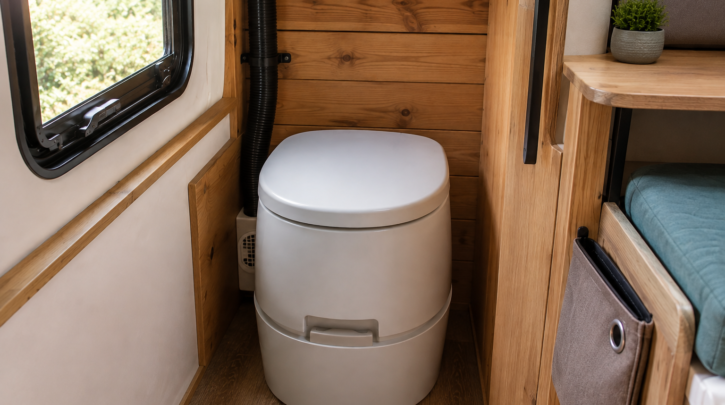

Van bathrooms are unforgiving: every inch matters, weight adds up fast against your build’s payload budget, and you’re usually running on a 12V system with limited amp-hours to spare for anything beyond the essentials. These five stood out as the strongest options once footprint, weight, power draw, and real-world van-builder feedback are all weighed together rather than judged on spec sheets alone.
Quick Comparison
| Model | Footprint (W x D) | Weight | Best For | Approx. Price* |
|---|---|---|---|---|
| OGO Origin | 16″ x 15″ | ~29 lbs | Smallest footprint, no cranking | $950–$1,000 |
| CompoCloset Cuddy | 15.1″ x 16.8″ | ~24 lbs | Best value, compact bench storage | $750–$850 |
| Nature’s Head | 20″ x 19″ | 23–28 lbs | Most proven, largest community support | $960–$1,095 |
| Air Head | 18.75″ x 19″ | 19–29 lbs (config-dependent) | Custom seat/tank configuration | $1,000–$1,100 |
| CompoCloset Cuddy Lite | 15.1″ x 16.8″ | ~20 lbs | Budget entry, bag-based (no agitator) | $650–$750 |
*Pricing shifts with promotions and shipping — always check the current listing before buying rather than treating these as fixed numbers.
How We Picked This Shortlist
Van bathrooms have a specific set of constraints that don’t apply the same way to a cabin or a larger RV, so we weighted this list specifically around them: exact floor footprint down to the inch, empty weight (since payload budgets in a van build are tighter than most people expect once you’ve added water tanks, batteries, and a kitchen), and 12V power draw for anything with an electric component. We deliberately excluded a couple of well-known cabin-oriented models from this particular list — they’re excellent products, just not the right shape or power profile for a van specifically. You’ll find them in our cabin buying guide instead.
OGO Origin — Smallest Footprint, Zero Cranking
At just 16 inches wide and 15 inches deep, the OGO Origin is one of the smallest composting toilets that still includes a powered agitator — a push-button 12V motor mixes the solids bin instead of a hand crank. The tradeoff is a smaller 25–30 use solids capacity than some larger competitors, and a motor that’s a mechanical part that can eventually fail, versus a hand crank that simply can’t. For most van builds where floor space is the binding constraint, this is currently the strongest pick on the market, and its built-in urine level sensor removes a common source of overflow surprises that plague less-instrumented competitors.
CompoCloset Cuddy — Best Value for the Space
Built specifically for van life rather than adapted from a boat or cabin design, the Cuddy’s boxy shape is designed to slot into bench seating, which is where most van builders end up placing a toilet anyway regardless of which brand they choose. It includes a built-in fan and carbon filter, a 1.7-gallon urine bottle with an LED level indicator, and a front-accessible agitator handle that several owners specifically cite as easier to service in place than a side-mounted crank. The Cuddy Lite variant drops the agitator in favor of a bag-and-bin method, which needs no power at all — a genuinely good option if you want to keep your build’s electrical system simpler, or if you’re not yet certain a composting toilet is right for you and want a lower-commitment entry point.
Nature’s Head — Most Proven Option
Nature’s Head has the longest track record in the van and boat community by a wide margin, with a hand-crank agitator — no motor to fail — and a solids bin rated for 60–80 uses, noticeably more than the compact competitors on this list. It’s larger than the OGO or Cuddy, so measure your intended footprint carefully before committing, but if you want the option with the most forum threads, YouTube installation walkthroughs, and spare-parts availability behind it, this is still it. The most consistent complaint from long-term owners is urine occasionally crossing into the solids chamber, which manufacturer guidance and most experienced owners attribute to seating position rather than a hardware flaw — worth reading up on before your first use rather than troubleshooting it after the fact.
Air Head — Configurable for Odd Spaces
Air Head’s standout feature is configurability: you can choose seat style, crank side, and urine tank size (3L or 7L) to fit an unusually shaped install that a fixed-configuration competitor simply can’t accommodate. That flexibility comes at a small premium — it’s typically the most expensive of the group covered here — and reviewers consistently note the urine tank viewing window is harder to read at a glance than Nature’s Head or OGO’s clearer level indicators, which has led to more than a few reported overflow surprises among long-term owners.
How to Choose
- Tightest floor space: OGO Origin or CompoCloset Cuddy
- Want the most community support and spare parts availability: Nature’s Head
- Want a fully custom fit for an odd-shaped space: Air Head
- Tightest budget, willing to empty more often: CompoCloset Cuddy Lite
Total Cost of Ownership Over Time
The upfront price differences between these five options are real, but they’re not the whole financial picture for a full-time van dweller. Carbon additive is a genuinely minor recurring cost across all of them — a bag of coco coir or sawdust lasts weeks and costs only a few dollars, regardless of which brand you chose. Where the numbers diverge more is in maintenance and replacement parts: a hand-crank design like Nature’s Head has essentially nothing to fail beyond the fan, while an electric-agitator unit like the OGO Origin carries a small ongoing risk of motor replacement after a year or two of heavy daily use, based on patterns reported by long-term owners. Neither cost is large in absolute terms, but if you’re budgeting for years of full-time use rather than a single season, it’s worth weighing mechanical simplicity alongside the sticker price.
What Long-Term Owners Wish They’d Known Before Buying
A few themes come up repeatedly across long-term owner reviews regardless of which specific model they chose. First, nearly everyone underestimates how much the urine container’s emptying frequency shapes daily routine compared to the solids side — it’s a smaller, more frequent chore that ends up mattering more day to day than the less frequent but more discussed solids emptying. Second, several owners of electric-agitator units specifically mention wishing they’d asked about manual fallback options before buying, since a motor failure mid-trip with no backup mixing method is a more disruptive problem than a simple hand crank breaking, which is a repair almost anyone can improvise in the field. Third, almost every reviewer, regardless of brand, mentions that reading the seating and positioning guidance before first use would have saved them an early, avoidable odor scare that they initially assumed meant something was wrong with the unit itself.
Before You Buy
- Confirm your floor cutout and any structural bracing needed — see our van installation guide for the full step-by-step process
- Plan your vent routing before you buy, not after — see our venting and ventilation guide for hose diameter and fan specs by brand
- Check your 12V system’s amp-hour budget if you’re choosing an electric-agitator model like OGO, especially if you’re already running a tight power budget with other appliances
Noise and Everyday Livability
Spec sheets don’t cover this either, but it’s a genuinely relevant factor in a small living space where the bathroom is often just a few feet from where you sleep. Fan noise across all five of these models is generally described as a quiet, low hum rather than anything disruptive, comparable to a small computer fan running continuously — which makes sense, since that’s essentially what’s inside most of them. The more noticeable noise difference is at the point of use: a hand-crank mechanism like Nature’s Head’s produces a brief mechanical sound during agitation that some owners specifically mention as reassuring — you can tell it’s working — while OGO’s electric agitator is close to silent by comparison, which some owners prefer and others find slightly less satisfying as direct feedback that mixing actually happened.
Frequently Asked Questions
Do I need to vent a composting toilet in a van?
Yes — every model on this list includes or requires a vent hose and exterior termination point for proper odor control and aerobic decomposition. Skipping this step is the single most common cause of odor complaints in van installs specifically.
Which one is easiest to install without professional help?
The CompoCloset Cuddy Lite is the simplest since it needs no power or venting at all, though you lose the composting function itself and need to empty more frequently as a result.
How much floor space do I actually need to budget?
Beyond the footprint itself, budget a few extra inches on at least one side for hand access during emptying, and vertical clearance above the unit to remove bins. See individual model dimensions in the comparison table above, and double-check against your actual floor plan rather than assuming a listed footprint accounts for real-world access needs.
Can two people share one of these full-time without constant emptying?
Yes, though the specific model matters — a smaller-capacity unit like the OGO Origin will need solids emptying roughly every 3–4 weeks for two full-time users, while Nature’s Head’s larger capacity can stretch closer to 4–6 weeks under the same usage. Liquids emptying is more frequent than solids regardless of model, typically every 1–3 days for two people.