
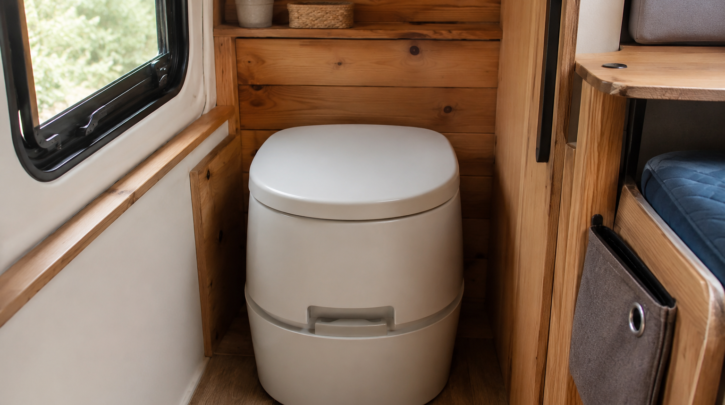

A composting toilet is a self-contained, waterless toilet system that separates and processes human waste on-site instead of flushing it away with water into a sewer or septic system. Solids are broken down by aerobic bacteria into a soil-like material, while liquids are usually diverted into a separate container for disposal. No water hookup, no black tank, no sewer connection required.
They’re used anywhere plumbing a flush toilet is impractical or impossible: vans, boats, cabins without septic, tiny homes, off-grid land, and backcountry camping. What’s changed in the last decade is how mainstream the category has become — what used to be a niche product for hardcore off-gridders is now a standard option in van conversion builds, tiny house plans, and even some suburban backyard sheds and workshops.
The Two Core Types
Self-Contained Units
Everything — the solids chamber, the urine bottle or tank, and usually a small fan — lives inside one compact unit that sits where a normal toilet would. This is what you’ll find in vans, RVs, and boats, and it’s the category most people picture when they hear “composting toilet.” Examples include Nature’s Head, OGO Origin, Air Head, and CompoCloset Cuddy. The main appeal is simplicity: one box, one install, nothing to plumb externally beyond a vent hose.
Central/Remote Systems
The toilet fixture is separate from a larger composting chamber, often located below the floor or in an adjacent utility space. These handle higher volumes and are more common in permanent cabin or home installations where space isn’t as constrained and multiple people are using the same system daily. The tradeoff is a more involved installation — you’re not just setting a box down, you’re planning for a chamber that may need its own access point for periodic maintenance.
Urine-Diverting vs. Non-Diverting
Most modern composting toilets are urine-diverting: a separate bowl or funnel section routes liquid waste away from solids before it ever mixes in. This single design choice matters more than almost any other feature, and it’s worth understanding why in some detail rather than just accepting it as a spec sheet bullet point.
- Solids composting relies on aerobic (oxygen-using) bacteria, which need a relatively dry environment to function efficiently
- Urine mixed into solids saturates the mix, cools it, and starves the aerobic bacteria — which allows anaerobic bacteria to take over instead
- Anaerobic decomposition is what actually produces the “outhouse” smell people associate with poorly maintained pit toilets — it’s a different biological process entirely, not just a more intense version of normal composting
- Diverted urine can be disposed of separately far more easily than a wet solid mix, whether that means dumping it, draining it, or in some setups diluting and using it as a nitrogen-rich fertilizer
Non-diverting designs — some DIY builds, some older commercial units — mix everything together, relying entirely on a carbon-rich additive (sawdust, coco coir, or peat moss) to manage moisture and maintain the aerobic conditions urine diversion handles automatically. Non-diverting systems can absolutely work, but they’re considerably less forgiving of inconsistent maintenance, and they’re the design most likely to produce genuine odor complaints when a user skips a step.
What a Composting Toilet Is Not
It’s worth clearing up two common mix-ups before you start comparing products, since the terminology in this space is genuinely inconsistent across manufacturers and regions.
- Not a chemical/cassette toilet. Cassette toilets use a small holding tank and chemical deodorizers, then need to be dumped at a designated dump station. No composting or biological breakdown happens at any point. See our full composting toilet vs. cassette toilet comparison for a direct side-by-side.
- Not an incinerating toilet. Incinerating toilets burn waste to ash using propane or electricity — a completely different category, with its own tradeoffs around fuel consumption, heat output, and upfront cost.
- Not the same as a “dry toilet” in every context. Most composting toilets are technically dry toilets, but not all dry toilets compost — some rely on lime or ash for pathogen reduction through desiccation rather than biological breakdown, a distinction that matters more in some international markets than in the US van-life and RV space.
Do Composting Toilets Actually Smell?
Properly installed and maintained, no — not noticeably, and this is genuinely the single most-asked question we get. Odor issues almost always trace back to one of three causes: inadequate venting, urine mixing into the solids chamber, or moisture content that’s too high because not enough carbon additive was used. None of these are inherent flaws in the technology — they’re maintenance and installation issues, and every one of them is fixable once you know what to look for. We cover the full diagnostic process in our smell and odor troubleshooting guide, including a quick-reference table matching specific smells to specific causes.
Is It Legal to Use One?
Generally yes, but the rules vary significantly by state and county, and the distinction between a vehicle installation and a permanent dwelling installation matters a lot here. Composting toilets in vans, RVs, and boats are rarely regulated at all, since they fall outside typical building and plumbing codes that govern fixed structures. Permanent installations in a home or cabin are a different story — some jurisdictions require NSF/ANSI 41 certification for the specific unit, some require a permit even for a certified unit, and a small number restrict composting toilets as the sole sanitation system on a property entirely. See our state-by-state legal requirements guide before installing one in a fixed dwelling, especially if it’s meant to be your only bathroom.
Who Actually Uses These
The user base is a lot broader than the “off-grid homesteader” stereotype suggests. Full-time van lifers make up a large share of the market, largely because a composting toilet removes the need to hunt down dump stations while boondocking. Cabin and tiny home owners use them where running a full septic line would be prohibitively expensive or physically impractical. Sailors and liveaboards use them to avoid holding-tank pump-outs and the marine sanitation regulations that come with a traditional marine head. And a growing number of suburban homeowners install them in workshops, sheds, and she-sheds where plumbing a bathroom from scratch simply isn’t worth the cost for occasional use.
How Urine Diversion Actually Feels to Use Day to Day
Spec sheets don’t cover this, but it’s usually the first thing new owners ask about once they’ve bought a unit: using a urine-diverting toilet requires sitting a bit differently than you would on a standard flush toilet, since the diverter is positioned to catch liquid at the front of the bowl. Most manufacturers publish specific seating guidance for exactly this reason, and it disproportionately affects users with a smaller frame, since correct positioning matters more for them than for larger users who naturally sit further back. The learning curve is real but short — most people report it becomes automatic within the first week of regular use, and manufacturers of nearly every major brand report that seating position, not a hardware defect, is the actual cause behind the large majority of “urine crossed into my solids bin” complaints they receive.
It’s also worth setting expectations for guests or occasional users who haven’t used one before — a quick explanation before their first use prevents almost all of the crossover issues that would otherwise show up later as an odor complaint with no obvious cause.
A Brief History of the Category
Urine-diverting dry toilets have existed in various forms for decades, with Swedish manufacturer Separett tracing its roots back to the 1970s, well before “van life” was a cultural phenomenon or a marketing category. Nature’s Head entered the self-contained market in the mid-2000s and became the default choice for sailors and early van conversion builders largely on the strength of word-of-mouth in boating forums. What’s changed more recently is the pace of new entrants — OGO, CompoCloset, and several European brands have all launched serious competing designs within roughly the last five years, largely riding the growth of van life as a mainstream lifestyle rather than a fringe pursuit. That competitive pressure has been good for buyers: prices have stayed relatively stable even as features like electric agitation and built-in level sensors have become common rather than exotic.
Where to Go Next
- How composting toilets actually work — the mechanics and science behind the process
- Best composting toilets for van life
- Best composting toilets for cabins
- How to build a DIY composting toilet
Frequently Asked Questions
Do composting toilets need electricity?
Most benefit from a small 12V or 120V fan for active ventilation, but non-electric models exist and rely on passive venting instead — typically at some cost to how reliably odor is controlled. See our electric vs. non-electric comparison for the tradeoffs in detail.
How often do you empty a composting toilet?
Solids typically every 3–6 weeks for one or two full-time users, depending on the model’s capacity; liquids every 1–3 days depending on tank size and how many people are using the unit. Full breakdown in our maintenance guide.
Can you use regular toilet paper?
Yes, though some heavy users switch to thinner or biodegradable single-ply paper to slightly slow solids buildup and reduce clumping in the chamber. It’s a preference, not a requirement.
How much does a composting toilet cost compared to installing plumbing?
Self-contained units generally run $650–$1,300 depending on brand and features. Installing a full septic-connected bathroom from scratch in an off-grid cabin, by comparison, frequently runs into the tens of thousands once a septic system, well, and code compliance are factored in — which is exactly why composting toilets have become the default choice for so many off-grid builds rather than a fringe alternative.