
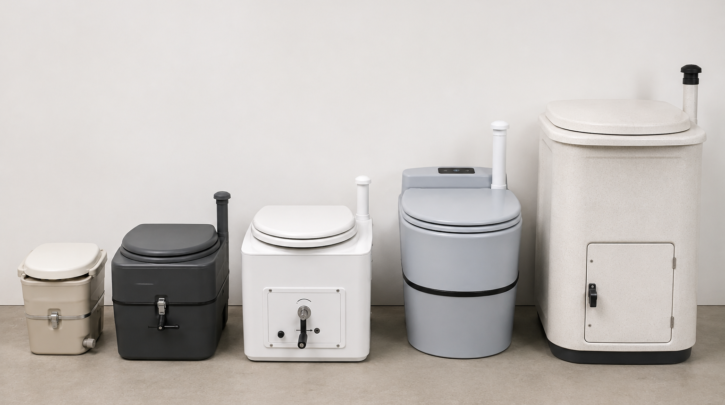

Every model reviewed across this site, sorted by exact footprint — from the smallest portable option to the largest cabin-scale system — so you can measure your actual space once and compare directly against real numbers.
This chart pulls dimensions directly from the individual reviews and buying guides elsewhere on this site, so if a specific model catches your eye here, the linked guide has the full picture — pros, cons, pricing, and who it’s actually best suited for.
Full Size Chart, Smallest to Largest
All dimensions listed as width x depth x height unless otherwise noted, matching the format used consistently across every individual review on this site.
| Model | Width | Depth | Height | Weight |
|---|---|---|---|---|
| OGO Nomad | 15.4″ | 12.38″ | 13″ | 9 lbs |
| BOXIO Toilet | 15.7″ | 11.8″ | 11″ | ~13–15 lbs |
| CompoCloset Cuddy | 15.1″ | 16.8″ | 16.3″ | ~24 lbs |
| OGO Origin | 16″ | 15″ | 18.375″ | ~29 lbs |
| Nature’s Head Weekender | 18″ | 18″ | 16.75″ | 20 lbs |
| Air Head (marine seat, small tank) | 18.75″ | 17.5″ | 19.75″ | ~18.75 lbs |
| Air Head (standard) | 18.75″ | 19″ | 19.75″ | 18.75–29 lbs |
| Nature’s Head (standard) | 20″ | 19″ | 21″ | 23–28 lbs |
| Separett Villa | 18″ | 26.5″ | 21.3″ | Check current spec |
| Sun-Mar Compact | Check current spec | Check current spec | Low-profile design | Check current spec |
| Sun-Mar Excel / Excel NE | Check current spec | Check current spec | Larger, residential-scale | Check current spec |
| Clivus Multrum (High Profile) | Varies by model (M1–M12) | Varies | ~750mm clearance needed | N/A — fixed installation |
| Clivus Multrum Low Profile | Varies by model | Varies | Reduced clearance for tight underfloor space | N/A — fixed installation |
Some cabin-scale models are listed as “check current spec” rather than a specific number — these are larger, configuration-dependent systems where exact dimensions vary meaningfully by model tier, and we’d rather send you to a current, accurate source than publish a number that could be outdated by the time you read this.
How to Actually Use This Chart
The numbers above are for the toilet body alone — they don’t account for the clearance you’ll actually need in real use. Add room on at least one side for reaching in during emptying, headroom above the unit to lift bins straight out, and space for the lid to open fully without hitting a wall or cabinet. A model that “fits” on paper based on footprint alone can still be genuinely unpleasant to service if you haven’t checked these secondary clearances — this is one of the most common regrets we hear from first-time buyers who measured only the base dimensions.
A practical approach: cut a piece of cardboard or tape out the footprint on your actual floor before ordering anything, then physically simulate reaching in, lifting a bin, and opening the lid. This five-minute exercise catches spatial problems that are much harder to spot from a spec sheet alone, and it’s considerably cheaper than discovering a fit problem after a unit has already arrived.
By Space Category
Tightest Spaces (Boats, Small Vans, Truck Campers)
OGO Nomad and BOXIO are the smallest footprints on this chart by a meaningful margin, both designed as portable units rather than permanently mounted fixtures — see our portable composting toilets guide for the full comparison. CompoCloset Cuddy is the smallest self-contained unit with a genuine agitator mechanism, and OGO Origin isn’t far behind it. If your available space is measured in single-digit inches of margin rather than a comfortable buffer, this tier is where you’ll find a genuine fit rather than forcing a larger unit into a space it wasn’t designed for.
Compact Van Conversions
Nature’s Head Weekender and Air Head’s marine-seat configuration both trade some capacity for a smaller, lighter footprint than their standard counterparts — worth considering if you’re building a smaller van conversion and don’t need maximum solids capacity. Full details in our small/compact composting toilets guide. This tier occupies a genuinely useful middle ground between the most compact portable options and full-size self-contained units, and it’s worth a close look if the tightest tier feels too limiting but a standard-size unit won’t quite fit your build.
Standard Vans and RVs
The standard Nature’s Head and Air Head configurations, along with the Separett Villa where an external drain is feasible, represent the most common footprint range for a dedicated van or RV bathroom with reasonably generous space. This is the sweet spot most first-time buyers land on once they’ve measured their actual bathroom cutout and found they have more room than the tightest compact options assume — worth checking this tier specifically before defaulting to a compact model out of an assumption that smaller is always necessary.
Cabins and Fixed Installations
Sun-Mar’s Excel and Excel NE, along with Clivus Multrum’s full range of batch systems, are built for a fixed footprint in a cabin or off-grid home rather than a vehicle — see our best composting toilets for cabins guide and our two-chamber and batch systems guide for the full picture on these larger-scale options.
Height Considerations Beyond the Toilet Itself
The height figures in the chart above measure the unit alone, not the total seated height once it’s mounted on a platform or riser, which several models require or benefit from. This matters most for shorter users or anyone installing in a space with limited headroom — a unit that’s already tall before adding any mounting platform can end up uncomfortably high once installed. If height is a genuine concern, check whether your chosen model needs a mounting platform at all, and factor that additional height into your headroom planning rather than working from the base unit height alone.
Related Guides
- Small/compact composting toilets for tight spaces
- Composting toilet capacity guide
- Composting toilet price comparison
Frequently Asked Questions
Do smaller footprints always mean smaller capacity?
Generally yes, though not perfectly proportionally — Air Head’s standard configuration, for instance, packs a relatively high solids capacity into a moderate footprint. Always check capacity separately from footprint rather than assuming one predicts the other.
Should I measure my space before or after choosing a model?
Measure first, including realistic clearance for emptying access and lid opening, then compare that measurement against this chart — choosing a model first and hoping it fits is a common source of installation headaches.
Are the dimensions listed here for the current model year?
These reflect verified specs as of mid-2026, but manufacturers do revise dimensions occasionally. Cross-check against the manufacturer’s current listing before finalizing a cutout or mounting plan, especially for a permanent installation.
Why don’t the cabin-scale models have exact dimensions listed?
These are configuration-dependent systems — Sun-Mar and Clivus Multrum both offer multiple model tiers with genuinely different dimensions depending on capacity needs, so a single number would be misleading rather than helpful. Check the specific model tier’s current spec sheet once you know your capacity requirements.
Do I need to account for the vent hose routing when measuring my space?
Yes — while the vent hose itself is thin and flexible, you need a clear path from the unit to an exterior wall or roof, plus the exterior vent cap’s own small footprint. This is separate from the toilet’s own dimensions and worth planning during the same measuring exercise, not as an afterthought.
Is there a standard “bathroom cutout” size these units are designed around?
No single universal standard exists — footprint varies meaningfully by brand and model as this chart shows. This is exactly why measuring your actual available space first, before shopping, matters more than assuming any given unit will fit a “typical” bathroom cutout.
Does a larger footprint always mean a more comfortable seat?
Not directly — seat comfort depends more on seat height and shape than overall unit footprint. Some larger units prioritize solids capacity over seat ergonomics, while some compact designs still manage a comfortable seat height through thoughtful shaping. Check individual reviews for comfort-specific feedback rather than assuming size alone predicts it.
If two similar-sized models have different weights, does that matter?
Weight matters most for portable units you’re carrying regularly, and for any installation where you’re mounting to a wall or platform rather than the floor, since mounting hardware needs to be rated for the actual weight. For a floor-standing permanent installation, weight differences within the ranges on this chart are rarely a practical concern.
Should I round up or down when a model’s footprint is close to my available space?
Round conservatively — leave a small buffer rather than choosing a model whose listed dimensions match your space exactly. Manufacturing tolerances, trim pieces, and the practical clearances covered earlier on this page all eat into a razor-thin margin faster than you’d expect.
Do any brands offer custom sizing for unusual spaces?
Not typically for the self-contained brands covered on this site — these are fixed manufactured products, not made-to-order. Clivus Multrum’s batch systems come closest to custom sizing, given their configuration-dependent design, but even there, custom sizing means choosing among a set model range rather than a truly bespoke build.
How often does this chart get updated as new models release?
We review and update dimensions whenever a covered brand releases a notable revision, though always cross-check against the manufacturer’s current listing for anything you’re about to purchase — a chart like this one is a strong starting reference, not a substitute for confirming the exact current spec before finalizing a cutout or order.