
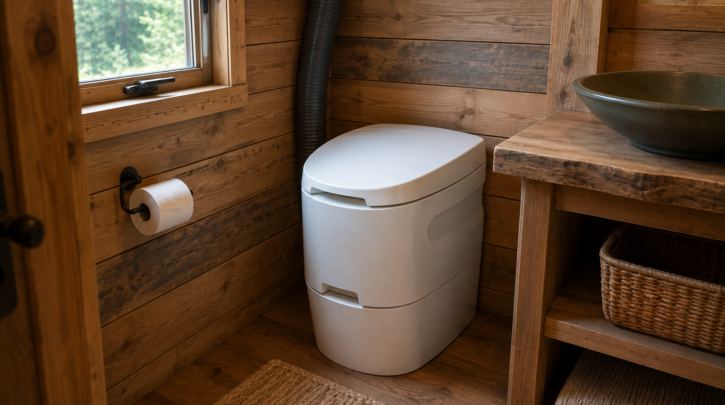

A cabin gives you something a van never can: real, fixed floor space, and often the option to route plumbing rather than being stuck with a fully self-contained box. That opens up bigger-capacity models built specifically for this use case — not just the compact van-oriented units we cover elsewhere on this site.
Quick Comparison
| Model | Capacity | Power Needs | Best For | Approx. Price* |
|---|---|---|---|---|
| Separett Villa | 6-gallon solids, external urine drain | 110–240V AC or 12V DC | Cabins with a drain line option | $1,000–$1,300 |
| Sun-Mar Excel | 3 adults residential / 6 adults weekend | 110V AC (heater + fan) | Larger cabins, weekend groups | ~$1,999 |
| Sun-Mar Excel NE | Same as Excel | None required (passive vent, optional 12V fan) | True off-grid cabins, no reliable power | Check current price |
| Nature’s Head | 60–80 uses | 12V fan only | Simpler, proven self-contained option | $960–$1,095 |
| Sun-Mar Compact | 1-2 residential / 3-4 seasonal | 110V AC (heater + fan) | Small cabins, cottages, bunkies | Check current price |
*Pricing shifts with retailer and promotions — always check the current listing before buying.
Sun-Mar Excel — Best for Larger Cabins and Weekend Groups
Of every brand covered across this site, Sun-Mar is the one built most specifically around cabin and cottage use rather than adapted from a van, boat, or general residential context — worth keeping in mind if you’ve been comparing primarily against the van-oriented brands covered in our other buying guides.
First launched in 1981 and still North America’s best-selling composting toilet, the Excel is rated for 3 adults in residential use or 6 adults for weekend and vacation use — genuinely more capacity than any self-contained van-oriented unit on this site, and built specifically around cabin and cottage use rather than adapted from a vehicle. It’s NSF/ANSI Standard 41 certified, the toughest composting performance standard in the industry, having been independently tested at maximum capacity for six continuous months without producing odor. The 2″ vent runs invisibly through a wall, and the unit ships with a 3-year parts warranty plus a 5-year warranty on the fiberglass tank specifically.
Sun-Mar Excel NE — Best for No Reliable Power
The Excel NE is a three-chamber variant of the same Excel design, engineered specifically for cabins with no continuous 110V supply. It needs no fan or heater to operate odor-free — the 4″ vent works like a chimney, using passive convection rather than powered airflow. An optional 12V fan (drawing just 1.4 watts, easily run off a small solar panel and marine battery) is available and recommended for heavy or full-time use, but the base unit genuinely doesn’t require it to function. This is the single most power-independent high-capacity option covered anywhere on this site.
Separett Villa — Best If You Can Route a Drain Line
Covered in full detail in our Separett Villa review, the Villa’s external urine drain design eliminates the daily bottle-emptying chore entirely — a genuine advantage for a cabin where you’re not fighting for floor space and can plan the drain routing into the build. It runs on both 12V DC and 110-240V AC, making it flexible for cabins transitioning between solar and grid power.
Nature’s Head — Best Simple, Proven Option
If you’d rather not deal with a drain line or a heater at all, Nature’s Head’s self-contained, hand-crank design remains the simplest option to install and maintain in a cabin, at the cost of a smaller capacity than the Sun-Mar Excel. Full details in our Nature’s Head review.
Sun-Mar Compact — Best for Small Cabins and Bunkies
For cabanas, bunkies, guest houses, and light cottage use, the Compact’s low-profile design and smaller three chambers trade some capacity for a footprint genuinely sized for tight cabin bathrooms rather than a full residential-scale install. It still needs a 110V outlet for its heating element and fan, plus a 2″ vent stack, but installation is otherwise straightforward.
How Cabin Installation Differs From a Van or RV Setup
The installation considerations covered in our van installation guide largely assume a fully self-contained unit with a short vent run and a compact urine bottle. Cabin installations open up meaningfully different options: a longer vent run is more feasible since you’re not constrained by a vehicle’s tight floor plan, an external drain line becomes practical in a way it rarely is in a van, and you have the option of hardwiring power directly rather than working within a 12V system’s amp-hour budget. This is exactly why the Sun-Mar Excel and Separett Villa — both less common choices for a van build — become genuinely strong options once you’re working with a cabin’s fixed floor plan and more flexible power situation.
The Total Cost Picture for a Cabin
Beyond the unit’s purchase price, budget realistically for a cabin-specific installation: a proper vent stack through an exterior wall or roof, any electrical work needed to bring power to the bathroom location if it isn’t already there, and — if you’re going with a Separett Villa or similar drain-based design — the drain line materials and routing labor. For a new-construction cabin where this is planned alongside the rest of the build, these costs are relatively modest add-ons to work already happening. For a retrofit into an existing cabin with no bathroom plumbing at all, budget more seriously for the electrical and venting work specifically, since that’s where most of the real installation cost and complexity lives, not in the toilet unit itself.
How to Choose
- Largest capacity for weekend groups: Sun-Mar Excel
- No reliable power at the cabin: Sun-Mar Excel NE
- Can route an external drain line: Separett Villa
- Want the simplest self-contained install: Nature’s Head
- Small cabin or bunkie: Sun-Mar Compact
Climate Considerations for Cabin Installations
A seasonal cabin faces a specific challenge none of the van or RV content on this site fully addresses: what happens to the unit during months of no use at all. Freeze risk is the biggest concern — any liquid left in a urine bottle, drain line, or tank can freeze and potentially crack components over a hard winter. For the Separett Villa’s drain-based design, this means fully draining the line before an extended closure, not just emptying the visible container. For self-contained units, both chambers should be emptied and left with lids slightly open to prevent moisture buildup during the closure. If your cabin sees regular winter use rather than sitting closed, an electric-assisted unit like the Sun-Mar Excel benefits from consistent heating to keep the composting process active through cold months, while the non-electric Excel NE will simply slow down until temperatures rise, without any risk of damage.
Before You Buy
Check your state and county’s permitting requirements before purchasing anything for a permanent cabin installation — see our legal requirements and permits by state guide. Most jurisdictions require NSF/ANSI 41 certification at minimum, and some require additional documentation specifically for how liquid waste is handled. If your cabin currently has or is considering a septic system instead, our composting toilet vs. septic system comparison breaks down the real cost and maintenance differences.
What Owners Say After a Full Season of Cabin Use
A pattern worth knowing about before you buy: cabin owners consistently report that their first season is the real test, not the sales pitch or the spec sheet. Weekend and vacation-use ratings (like the Sun-Mar Excel’s 6-8 person figure) hold up well in practice for exactly what they’re rated for — occasional heavy weekend use followed by longer idle stretches during the week. Where expectations and reality diverge most is in year-round or near-full-time cabin use, where the same unit performs closer to its lower residential-use rating than its higher weekend rating, simply because there’s no idle recovery period between uses. If you’re planning to live in your cabin full-time rather than visiting on weekends, size your choice around the residential rating, not the weekend rating, even if the weekend number is the one that catches your eye in marketing copy.
Related Guides
- Best composting toilets for off-grid homes
- Legal requirements/permits by state
- Composting toilet vs. septic system
Frequently Asked Questions
Do I need a permit to install a composting toilet in a cabin?
In most jurisdictions, yes, or at minimum the unit needs to be NSF/ANSI 41 certified and reviewed by your local health department alongside any septic or wastewater permitting. Requirements vary significantly by state and county — see our full legal guide before buying.
Can a cabin composting toilet replace a septic system entirely?
It can replace the toilet’s contribution to a wastewater system, but most cabins still need some form of greywater handling for sinks and showers, and many jurisdictions require this even when a composting toilet handles all toilet waste. See our vs. septic comparison for the full breakdown.
How many people can a cabin composting toilet realistically support?
This varies enormously by model — a compact self-contained unit like Nature’s Head supports 1-2 full-time users comfortably, while a high-capacity unit like the Sun-Mar Excel is rated for a family of 5 in residential use or up to 8 people for weekend and vacation use.
Is a non-electric option like the Excel NE worth the tradeoff?
If your cabin genuinely has no reliable power source, yes — it’s one of the few high-capacity options that doesn’t depend on continuous electricity to function. If you have reliable power anyway, the standard electric Excel’s heater generally speeds composting and manages moisture more actively.
Can I mix and match — a compact unit now with an upgrade path to a bigger system later?
Generally not as a direct upgrade the way CompoCloset’s Cuddy/Cuddy Lite line allows, since these cabin-oriented brands don’t share that kind of modular design across capacity tiers. If you expect your cabin’s usage to grow significantly, it’s more cost-effective to plan for that eventual capacity from the start than to buy a smaller unit now expecting to swap it out later.