
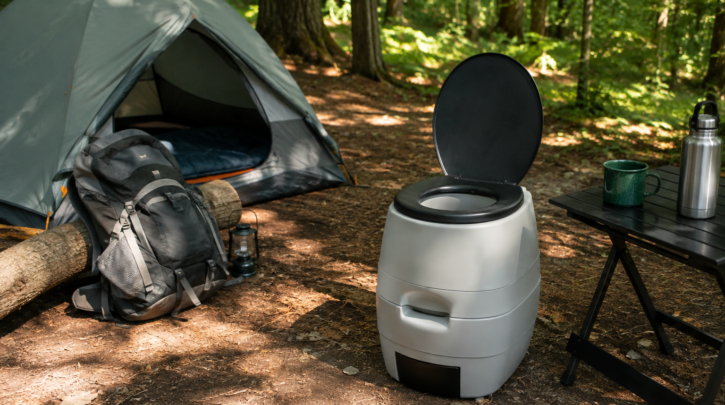

Camping and weekend trips call for a genuinely different category of composting toilet than a van build or a cabin. You want something you can toss in a trunk, set up in minutes with no tools, and pack away just as fast — not a permanently mounted unit with a vent hose and 12V wiring. A handful of brands have built their entire product around exactly this use case, and they’re worth knowing about even if you’ve already read our van life or cabin buying guides.
This is also the segment of the market that’s grown fastest in the last few years, largely driven by European brands entering the US market and by van lifers and campers who want the environmental and cost benefits of composting without committing to a permanently mounted, vented installation.
Quick Comparison
| Model | Weight | Setup | Capacity | Approx. Price* |
|---|---|---|---|---|
| OGO Nomad | 9 lbs | No tools, ready in seconds | 8–10 uses per bag; urine bottle ~1.2 gal, empty every 1–2 days | ~$269 |
| BOXIO Toilet | ~13–15 lbs | No tools, assembled in under 5 minutes | 8–10 uses; 5L solids container, leak-proof urine canister | $180–$230 |
| Trelino Evo | Varies by size (S/M/L) | No tools | Larger capacity than Boxio/Nomad; multiple size options | $375+ |
| CompoCloset Cuddy Lite | ~20 lbs | Minimal — designed for semi-permanent mounting too | Bag-based, no agitator | $650–$750 |
*Pricing shifts with promotions — always check the current listing before buying.
OGO Nomad — Best for Grab-and-Go Simplicity
At just 9 lbs and roughly 12.4″ x 15.4″ x 13″, the Nomad is built specifically for the camping and hunting-blind use case rather than adapted from OGO’s self-contained Origin model — no power, no venting, no installation of any kind. Its urine-diverting bowl separates liquid into a front bottle while solids collect in a compostable bag at the rear, using a simple layering method with coco coir rather than an agitator. Replace the bag every 8–10 uses, empty the urine bottle every 1–2 days, and there’s genuinely nothing else to it. It ships with a 3-year warranty, which is notable for a product in this price tier.
BOXIO Toilet — Best Established Budget Option
Made in Rostock, Germany, and marketed as Europe’s best-selling composting toilet, BOXIO fits inside a standard “eurobox” form factor — compact, straight-walled, and easy to stack alongside other camping gear. It uses hemp husk as its odor-binding medium, holds 8–10 uses in its 5-liter solids container, and includes a leak-proof urine canister. Full details in our BOXIO review.
Trelino Evo — Best If You Want More Capacity and Configuration Options
Trelino sits a tier above BOXIO and the Nomad on price, but it offers something neither does: multiple size options (S, M, L) so you can match capacity to your actual trip length and party size rather than accepting one fixed size. It uses the same layering, no-agitator approach as the budget options, made in Germany with what reviewers consistently describe as noticeably higher build quality and more finishing touches — a wooden lid option on the pricier Origin line, for instance — than the budget tier offers.
CompoCloset Cuddy Lite — Best If You Might Upgrade to a Permanent Install Later
The Cuddy Lite, covered in more detail in our CompoCloset Cuddy review, costs meaningfully more than the dedicated portable options here, but it’s worth considering if you’re camping out of a vehicle you might eventually convert into a more permanent van build — it’s designed to work equally well set on the floor for a weekend trip or semi-permanently mounted later, which none of the pure portable options are built to do.
How to Choose
- Lightest, simplest option: OGO Nomad
- Most established budget brand: BOXIO
- Want size options to match trip length: Trelino Evo
- Might upgrade to a permanent build later: CompoCloset Cuddy Lite
What You Give Up Compared to a Self-Contained Van Unit
Every option on this page trades capacity and hands-free convenience for portability and price. None of these use an agitator, which means no mixing mechanism to fail, but also no way to redistribute material within a chamber — you’re relying entirely on layering fresh carbon additive after each use and replacing the bag on schedule. Urine capacity is also considerably smaller than a van-oriented unit like Nature’s Head, which means daily rather than every-few-days emptying. For occasional weekend and week-long trips, none of this is a real drawback; for full-time living, the self-contained units covered in our van life buying guide are the better fit.
Packing and Storage Between Trips
One advantage worth calling out specifically for the camping use case: every option here is designed to be cleaned, dried, and stored compactly between trips rather than living permanently mounted somewhere. This matters for anyone without a dedicated van or RV — a camper who stores gear in a garage or closet between trips benefits directly from a design built around exactly that pattern of use, unlike a self-contained unit that assumes it’s staying mounted in one place indefinitely. Give the solids and liquids containers a thorough clean and let them dry fully before long-term storage between camping seasons, the same general principle covered in our extended-storage guidance elsewhere on this site.
How We Picked This Shortlist
Camping and portable use has a different priority order than a van or cabin build: setup speed and weight matter more than raw capacity, since these units are meant to be packed away between trips rather than living permanently mounted somewhere. We weighted this list around exactly that — how quickly you can go from packed-away to ready-to-use, how much it weighs when you’re the one carrying it from a trunk to a campsite, and how forgiving the design is for someone who might only use it a handful of weekends a year rather than daily. We deliberately excluded the larger cabin-oriented brands from this list even though some technically could be used while camping — they’re simply not built around this specific use case the way BOXIO, the Nomad, and Trelino are.
Total Cost for Occasional Use
For someone camping a handful of weekends a year, the math looks different than it does for a full-time van dweller. A $200–$300 portable unit amortized over several seasons of occasional use costs very little per trip, and ongoing costs are limited to inexpensive carbon additive and the occasional replacement bag — genuinely minor expenses at this usage level. This is worth keeping in mind if you’re tempted to go even cheaper with a basic chemical portable toilet instead; the price gap narrows considerably once you’re comparing total cost across a few seasons rather than just the upfront sticker price, a comparison we walk through in more detail in our portable toilet vs. composting toilet guide.
Group Camping Considerations
If you’re outfitting a group campsite or a shared basecamp rather than buying for personal or family use, capacity math shifts quickly — an 8–10 use solids bag stretches much less far across four or five people than it does for one or two, and it’s worth budgeting for either a higher-capacity option like Trelino’s larger sizes or simply packing more spare bags and medium than you’d expect for the group size. Liquids emptying frequency also compounds fast with more users sharing one unit, so plan for a genuinely daily routine rather than the every-other-day pace a solo camper might get away with.
What to Pack Alongside the Toilet
Beyond the unit itself, a small supply kit makes the difference between a smooth trip and a frustrating one: extra compostable bags, a sealed container of coco coir or sawdust sized for your trip length, hand sanitizer or wipes since running water isn’t guaranteed at most campsites, and a small trowel or bag for solids disposal if you’re somewhere pack-out rules apply. None of this is expensive or heavy, but forgetting it is the most common reason a first-time composting toilet camping trip goes poorly — not the toilet itself failing to perform as expected.
Related Guides
- Best budget composting toilets under $300
- BOXIO Review
- Portable toilet vs. composting toilet for camping
Frequently Asked Questions
Do portable composting toilets smell in a tent or small car?
Not when used correctly — the same urine-diversion principle covered in our odor guide applies here, just without active fan ventilation. Since there’s no powered vent, staying on top of bag changes and carbon additive matters even more than with a vented self-contained unit.
Can I use a portable composting toilet inside a tent?
Yes, many campers do exactly this for overnight convenience, though good general tent ventilation helps manage the brief odor that occurs right after solid use, the same as with any composting toilet.
How do I dispose of solids while camping?
This depends entirely on local regulations for the specific land you’re on — some areas allow properly bagged solids in regular trash receptacles, others require pack-out, and backcountry areas often have specific rules. Check with the land management agency for your specific location before your trip rather than assuming.
Are these portable options durable enough for repeated use over several seasons?
Generally yes — OGO’s 3-year warranty on the Nomad and consistent positive long-term reviews for BOXIO and Trelino suggest reasonable durability for a product in this price tier, though none carry the same multi-decade track record as Nature’s Head or Air Head in the van/RV category.