
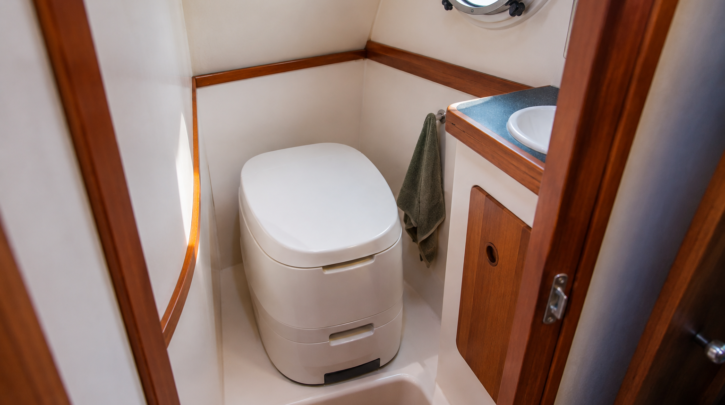

Boats add a specific wrinkle to every consideration covered elsewhere on this site: motion, salt air, and marine sanitation regulations that don’t apply to a van or cabin. The right choice splits fairly cleanly between full-time liveaboards and occasional day boaters.
Sailors and liveaboards have historically been one of the core early-adopter communities for composting toilets generally, well before van life turned the category into a mainstream product category — a fact that shows up clearly in how mature and marine-tested brands like Air Head and Nature’s Head are compared to some of the newer van-focused competitors covered elsewhere on this site.
For Full-Time Liveaboards: Air Head or Nature’s Head
Both brands have deep roots in the sailing community specifically, and for good reason. Air Head, covered in full in our Air Head review, was built with marine use as a core design consideration from the start — its rubber-sealed lid and seat and dedicated marine-seat configuration with a smaller urine tank option are specifically suited to a wet-bath-style marine head. Nature’s Head, covered in our Nature’s Head review, has an equally long history at sea, with its hand-crank design offering the same no-motor-to-fail reliability that makes it a strong choice on land — arguably even more valuable on a boat, where sourcing a replacement part quickly isn’t always realistic.
For Day Boaters and Weekend Sailors: BOXIO, OGO Nomad, or Trelino
All three budget-and-portable options covered in our portable composting toilets guide are explicitly marketed for boating alongside camping and hunting use, and for good reason — a boat used for day trips or occasional weekends doesn’t need Air Head’s or Nature’s Head’s capacity, and the lighter, more compact portable options stow easily when not in use rather than occupying a permanently mounted marine head space.
Sailboats vs. Powerboats vs. Houseboats
Vessel type shapes this decision almost as much as usage frequency does. Sailboats, especially smaller cruisers, tend to have the tightest head compartments of any vessel category, which makes a compact permanent option like Air Head’s marine configuration or a stowable portable unit particularly appropriate. Powerboats used mainly for day trips rarely have a dedicated head at all, making a portable option the practical default rather than a compromise. Houseboats and larger live-aboard vessels have more in common with a small cabin than with a typical boat, and can reasonably consider the same cabin-oriented brands — Separett Villa or even a compact batch system — covered in our cabin and off-grid content, provided the vessel has the underfloor or utility space those systems require.
Weight and Balance Considerations
Boats are more weight-sensitive than most people expect, particularly smaller sailboats where weight distribution affects handling and trim. A permanently mounted self-contained unit’s weight is a one-time, fixed consideration during installation planning, while a portable unit’s lighter weight (9 lbs for the OGO Nomad, for instance) matters more if it’s regularly being moved on and off the boat rather than staying in a fixed spot. For a smaller vessel where every pound is accounted for, factor the toilet’s weight into your overall load planning the same way you would any other gear, rather than treating it as negligible simply because it’s small.
Chartering and Shared-Boat Considerations
If you charter your boat or share it among multiple owners or crews, a composting toilet introduces a genuine consideration a traditional marine head doesn’t: guests and renters unfamiliar with urine-diverting seating will need a brief explanation before their first use, the same guidance covered throughout this site for any shared or guest-facing installation. For a chartered vessel specifically, a simple laminated instruction card near the toilet is worth the small effort — it prevents the confusion that would otherwise show up as an unexplained odor complaint after a charter guest’s stay, without requiring you to personally walk every guest through the process.
Converting Away From a Traditional Marine Head
Beyond the physical retrofit covered above, switching from a traditional marine head with a holding tank to a composting system changes your relationship with pump-out stations entirely — for boaters who’ve spent years planning trips partly around holding tank capacity and pump-out availability, this is a genuine lifestyle change worth appreciating before committing to the switch. Many long-time liveaboards who’ve made this conversion specifically cite the freedom from pump-out logistics as the single biggest quality-of-life improvement, often more valued in practice than the environmental or cost benefits that initially motivated the switch.
Marine-Specific Considerations Beyond the Toilet Itself
- Motion at anchor and underway: secure mounting matters more here than in a stationary cabin — Air Head and Nature’s Head both include hardware suited to a moving vessel, but confirm your specific mounting approach can handle real chop, not just calm-water use.
- Salt air and corrosion: check that hardware, hinges, and fan housings are rated for a marine environment specifically — a van-rated unit’s standard hardware may corrode faster in salt air than a purpose-built marine unit’s would.
- Marine sanitation regulations: in US waters, discharge of sewage is regulated separately from land-based composting toilet rules — a composting toilet’s appeal for many boaters is specifically that it avoids the Marine Sanitation Device (MSD) requirements and holding-tank pump-out logistics that come with a traditional marine head, but confirm current Coast Guard and state-specific regulations for your cruising area rather than assuming this is universally settled.
Ventilation in a Marine Head
The same principles from our general venting and ventilation guide apply on a boat, with one added wrinkle: a marine head is often smaller and more enclosed than even a van bathroom, and existing boat ventilation systems (dorade vents, powered exhaust fans) may need to be coordinated with the toilet’s own vent to avoid odor migrating into the cabin through an unrelated air path. Plan this specifically during installation rather than assuming the toilet’s own fan handles everything independent of the boat’s broader ventilation.
Retrofitting an Existing Marine Head
Many boaters come to composting toilets after years with a traditional marine head and holding tank, and the retrofit is usually more straightforward than people expect, since a marine head compartment is already built around a toilet fixture with some plumbing infrastructure nearby. The existing holding tank and thru-hull discharge fittings typically get decommissioned rather than reused — check with a marine surveyor or your boat’s specific systems documentation before assuming any existing fitting can simply be repurposed for the new vent hose, since marine hardware isn’t always a direct match for what these composting units expect. Budget for this as a genuine small project, similar in scope to the cabin retrofit considerations covered in our cabin buying guide, rather than a simple drop-in swap.
Related Guides
Frequently Asked Questions
Do composting toilets avoid marine sanitation device requirements?
Often, yes, since MSD regulations are generally written around discharge of sewage overboard rather than a fully contained composting system — but confirm current Coast Guard and state-specific rules for your specific cruising waters rather than assuming this applies uniformly everywhere.
Will a composting toilet work in rough seas?
Properly and securely mounted units generally handle normal boat motion without issue, though extended heavy weather can make emptying and cleaning tasks more awkward than in calm conditions, the same as any onboard task.
Is a portable composting toilet enough for a small sailboat with no dedicated head?
Yes, this is a common and reasonable use case — a portable option like BOXIO or the OGO Nomad can be stowed when not in use and set up as needed, which works well for smaller boats without a dedicated permanent head compartment.
How often do liveaboards typically empty a marine composting toilet?
Similar to van and RV usage patterns covered in our maintenance guide — liquids every 1–3 days, solids every few weeks — though confirm proper disposal locations for solids specifically, since dumping requirements differ between marinas, open water, and shore-based facilities.
Do I need a different unit for saltwater versus freshwater boating?
The toilet itself functions identically regardless of water type, since it never contacts the water the boat sits in. The relevant difference is corrosion exposure — saltwater environments are harder on any exposed hardware, which is why marine-rated components matter more for saltwater use specifically than for a freshwater lake boat.
Can I install a composting toilet in a boat myself, or do I need a marine professional?
Many boaters install these units themselves, particularly the portable options which need no installation at all. For a permanent, vented installation replacing an existing marine head, a marine professional’s input is worth it if you’re not confident working with your boat’s specific plumbing and structural layout, given how much variation exists between vessel designs.
Do marinas typically accept composting toilet solids for disposal?
This varies by marina and jurisdiction — some accept properly bagged solids in regular trash receptacles, others don’t. Check with your specific marina’s policy or local waste regulations before assuming disposal there is acceptable.