
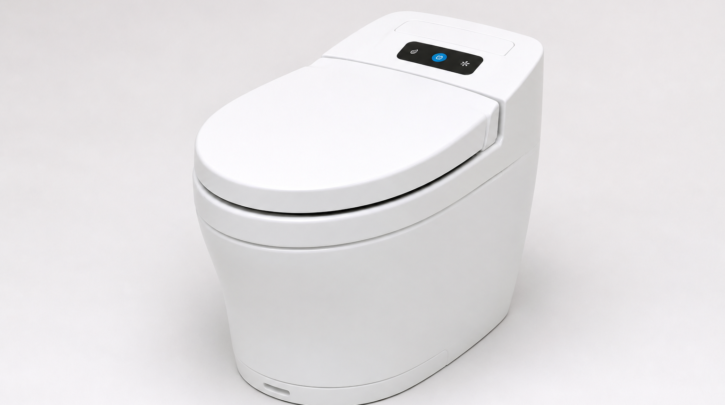

OGO’s Origin model is one of the newest serious entries in the self-contained composting toilet category, and it’s built around one standout feature: a push-button electric agitator that replaces the hand crank found on Nature’s Head and Air Head. That single design choice shapes almost everything else worth knowing about this unit, for better and worse.
Specs at a Glance
| Dimensions | 16″W x 15″D x 18.375″H |
|---|---|
| Weight | ~29 lbs (13 kg) |
| Solids capacity | 25–30 uses |
| Urine bottle | 2.4 gallons, with a level sensor light |
| Agitator | 12V push-button electric mixing (no manual crank) |
| Weight capacity | Up to 550 lbs (per manufacturer) |
| Vent hose | 5′ included with swivel vent, extendable with standard HT pipe |
| Price | Approx. $950–$1,129 (check current price) |
Who Actually Buys This One
OGO’s buyer base is heavily weighted toward newer van builds, particularly Sprinter and Transit conversions where the bathroom footprint is planned from scratch around the toilet rather than the toilet being fit into an existing space. It’s also a common choice among buyers who specifically want to avoid a hand-crank mechanism — some for comfort or mobility reasons, others simply because they find the idea of pressing a button more appealing than manually turning a handle after every use. It’s a less common pick for boats and older RV retrofits, where Nature’s Head’s longer track record and simpler mechanical design tend to win out.
What It Gets Right
- Smallest footprint among electric-agitator units. At 16″x15″, it fits corners and cabinet cutouts that rule out most other full-featured composting toilets — a specific advantage in Sprinter/Transit-style van conversions where every cabinet dimension is already tightly planned.
- Zero manual cranking. The push-button motor handles mixing, which matters for anyone with grip or mobility limitations, or who simply finds hand-cranking after every use tedious over months of daily use.
- Built-in urine level sensor removes the guesswork some competitors’ opaque viewing windows create, directly addressing a complaint that shows up repeatedly against Air Head specifically.
- Modern, appliance-like design that several van builders specifically cite as looking intentional rather than utilitarian in a finished build — a genuinely subjective point, but one that comes up often enough in reviews to be worth mentioning.
What Comes Up as Complaints
- Smaller solids capacity than Nature’s Head or Separett. At 25–30 uses, expect to empty roughly every 3–4 weeks for one to two full-time users — noticeably more often than the larger competitors, which is a real day-to-day tradeoff for the smaller footprint.
- The electric agitator is a mechanical failure point. Some owners report motor issues after 12–18 months of heavy use — a risk that simply doesn’t exist with a hand-crank design, and there’s no easy manual fallback if the motor fails mid-trip.
- Premium pricing relative to budget-tier competitors like CompoCloset Cuddy, without a correspondingly larger capacity to justify the gap on paper.
The Installation Experience
OGO’s smaller footprint is a genuine installation advantage in a van build where cabinet space is planned tightly around the unit, but the electric agitator adds a wiring consideration that hand-crank competitors don’t have — you’re powering not just a fan but a small motor, which means slightly more attention to your 12V budget than a Nature’s Head install would require. The included 5-foot hose with swivel vent covers most standard installs without modification, and the DN40 HT pipe compatibility for extensions means hardware-store parts work fine if you need a longer run than what’s included, consistent with the general venting guidance covered in our venting and ventilation guide.
Long-Term Durability
Because OGO is a considerably newer brand than Nature’s Head or Separett, the long-term durability picture is less established simply due to fewer years of units in the field. What data does exist points to the electric agitator motor as the component to watch — the 12–18 month failure pattern reported by some heavy-use owners is specific enough to be a genuine consideration rather than an isolated fluke, though it’s worth noting this affects a minority of units rather than being a universal experience. The housing and level sensor components don’t show a similar pattern of complaints, suggesting the motor specifically, rather than the unit generally, is where durability risk concentrates.
Who It’s Best For
Van and tiny-space builds where footprint is the single biggest constraint, and for anyone who specifically wants to avoid a hand-crank mechanism. Full-time users who empty every few weeks without much friction will get the most value from the smaller size tradeoff, particularly if they’re comfortable with — or simply unaware of — the modest motor reliability risk relative to a purely mechanical alternative.
Battery and Solar Compatibility in Practice
For van builders running a modest solar setup, it’s worth thinking through the OGO’s combined power draw realistically rather than assuming “12V” automatically means “trivial load.” The fan alone is low-draw and easily absorbed by almost any setup, but the agitator motor’s brief activation draws meaningfully more current during actual mixing than the fan does continuously — not enough to be a genuine concern for most van electrical systems sized for typical loads like lighting, a fridge, and device charging, but worth confirming against your specific battery capacity and solar input if you’re already running close to your system’s limits with other appliances.
Who Should Look Elsewhere
If you want the largest possible stretch between empties, Nature’s Head or Separett Villa both offer meaningfully more solids capacity. If a mechanical failure with no manual fallback is a dealbreaker for your use case — extended remote trips where a replacement part could take a while to arrive, for example — a hand-crank design removes that risk from the equation entirely.
Verdict
The strongest choice specifically for tight van floor plans where the electric agitator’s convenience outweighs its slightly higher failure risk and smaller capacity. Not the best pick if capacity or mechanical simplicity matters more to you than footprint and the appeal of push-button operation.
Common Repairs and Replacement Parts
The electric agitator motor is the component to watch, consistent with the failure pattern discussed above, and it’s worth asking OGO directly about motor replacement cost and turnaround time before buying if this is a genuine concern for your use case — particularly for anyone planning extended remote travel where sourcing a replacement part quickly might not be realistic. The urine level sensor and fan are both less commonly reported as failure points, and standard 12V fan replacement follows the same general pattern as every other brand on this list.
How It Stacks Up Against the Rest of the Field
Against Nature’s Head, OGO wins on footprint and ease of use but loses on capacity and mechanical reliability track record. Against CompoCloset Cuddy, OGO wins on solids capacity and the push-button agitator but loses significantly on price for a buyer who doesn’t specifically need the electric mixing feature. Against Separett Villa, the comparison again comes down to installation type — OGO’s self-contained design fits a van, while Separett’s drain-based approach doesn’t, making direct comparison less meaningful than sorting by which installation category actually applies to your build.
Related Guides
What to Confirm Before Ordering
Before committing to the OGO specifically because of its footprint, confirm your 12V system has comfortable margin for the agitator motor’s draw alongside the fan, particularly if you’re already running a tight power budget with other appliances in a solar-dependent van. It’s also worth directly asking about current motor warranty terms and typical repair turnaround, since this is the one component genuinely more prone to failure than on a hand-crank competitor, and knowing the actual support process in advance is more useful than discovering it only after something breaks mid-trip.
Frequently Asked Questions
What happens if the OGO’s electric agitator motor fails?
There’s no manual crank fallback built in — a failed motor means the mixing function stops working until repaired or replaced, which is the tradeoff for the push-button convenience.
Does OGO require a separate power adapter for 110V use?
Yes — the unit runs on 12V natively, and a separate power adapter is needed to run it from a standard household outlet.
How does the OGO’s solids capacity compare in practice?
At 25–30 uses, one to two full-time users typically empty every 3–4 weeks — shorter than Nature’s Head’s 60–80 use rating, so factor that into your maintenance routine expectations before buying based on footprint alone.
Is the urine level sensor reliable, or does it need occasional manual checking anyway?
Owner reports are generally positive on the sensor’s accuracy, though as with any electronic indicator, an occasional visual check is reasonable insurance rather than relying on it exclusively, especially during the unit’s first few months of use while you’re still calibrating your own sense of typical fill rate.
How does OGO’s price compare once you factor in the electric agitator feature?
It sits toward the upper end of the mainstream price range covered on this site, roughly comparable to Nature’s Head despite a smaller solids capacity — the premium reflects the electric agitator and compact engineering rather than raw capacity, so it’s worth deciding how much that specific feature is worth to you personally before comparing purely on price per gallon of capacity.