
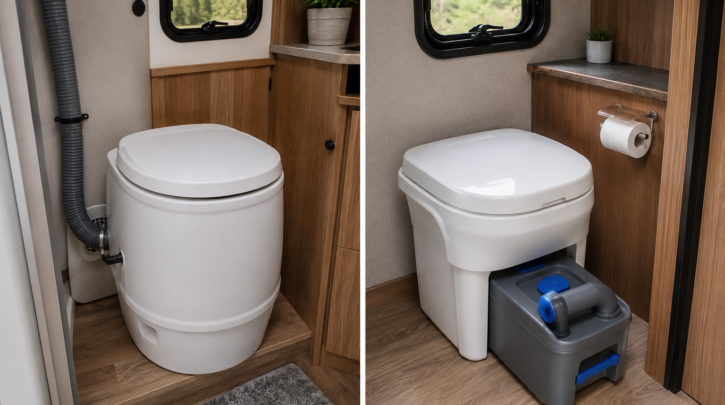

These are the two dominant options for vans, RVs, and boats without a full plumbing hookup, and picking wrong means either overpaying for capability you don’t need, or fighting a system that doesn’t fit your travel style for as long as you own the vehicle. Here’s the actual difference, not just the marketing pitch each side makes about itself.
How Each One Works
Cassette/chemical toilets use a small flush — often a hand-pump or electric — that carries waste into a removable holding tank, called a cassette, pre-dosed with a chemical deodorizer. When the cassette fills, you remove it, carry it to a dump station or an approved toilet, and empty it there. There’s no biological process happening at any point; the chemical is purely masking odor until you can dispose of the contents properly.
Composting toilets separate liquid and solid waste at the source, use a carbon additive and active airflow instead of chemicals to control odor, and let aerobic bacteria begin breaking solids down — no dump station required, since disposal is far more flexible and, in most jurisdictions, far less restricted by location.
Side-by-Side Comparison
| Factor | Composting Toilet | Cassette/Chemical Toilet |
|---|---|---|
| Upfront cost | Higher (roughly $650–$1,300+) | Lower (roughly $100–$400) |
| Ongoing cost | Carbon additive only (cheap, buy in bulk) | Chemical deodorizer cartridges (recurring, adds up over years) |
| Water use | None | Small amount per flush |
| Emptying logistics | Flexible — no dump station required for liquids; solids per local rules | Requires a dump station or designated disposal point |
| Emptying frequency | Solids: weeks; liquids: 1–3 days | Every 3–5 days for average use, tank-size dependent |
| Odor control method | Ventilation + carbon additive + diversion | Chemical deodorizer |
| Environmental footprint | Lower — no chemicals, waste can be composted per regulation | Higher — chemical cassette waste needs proper disposal facilities |
| Footprint/weight | Generally larger and heavier | Generally smaller and lighter |
| Best for | Full-time living, longer trips, boondocking away from dump stations | Occasional use, shorter trips, easy access to campgrounds/dump stations |
What a Week Actually Looks Like With Each One
Numbers on a spec sheet only tell you so much — the day-to-day experience is what actually determines whether you’ll be happy with your choice a year in. With a cassette toilet, your week is built around the cassette’s capacity: for two people using it full-time, that’s typically a dump-station trip every 3–5 days, which means your route planning has to account for where those stations are. Miss that window and you’re stuck with an overflowing, chemical-laced tank in a small space — not a pleasant afternoon.
With a composting toilet, the liquids container is actually the more frequent chore — typically every 1–3 days — but it can be dumped almost anywhere appropriate, not just at a designated station, which removes the routing constraint entirely. The solids side, meanwhile, only needs attention every few weeks, and even then the disposal options are broader than a cassette’s single-point dump station model.
The Real Five-Year Cost Picture
A cassette toilet’s lower upfront cost is real, but it’s not the whole financial story. Chemical deodorizer cartridges are a recurring expense that adds up meaningfully over years of regular use, and dump station fees at some private campgrounds and marinas aren’t always free. A composting toilet’s carbon additive — sawdust, coco coir, or peat moss — costs a small fraction of chemical cartridges per equivalent period of use, which means the higher upfront price gradually narrows over years of ownership, particularly for full-time travelers putting the toilet through heavy daily use rather than occasional weekend trips.
Choose a Cassette Toilet If:
- You travel mostly between campgrounds or RV parks with dump stations nearby
- You want the lowest upfront cost and the simplest possible install
- Your trips are short enough that a 3–5 day cassette capacity is genuinely plenty
Choose a Composting Toilet If:
- You boondock or camp off-grid for extended periods, away from dump stations
- You live in your rig full-time and want to minimize recurring costs and chemical use over years of ownership
- You’d rather empty more often but in more places, than less often but only at specific stations
The Real Tradeoff
It comes down to logistics versus upfront cost, more than any other single factor. A cassette toilet is cheaper and simpler but ties your travel plans to dump station access, which can quietly shape your entire route if you’re not careful about it. A composting toilet costs more upfront but frees you from that constraint almost entirely — at the cost of a bit more day-to-day management: carbon additive to keep stocked, a urine container to empty more frequently, and occasional agitation to keep the solids chamber working properly.
Weight and Installation Complexity Compared
Cassette toilets generally win on both counts, and it’s worth being honest about that rather than glossing over it because the rest of the comparison favors composting toilets. A typical cassette unit is lighter and smaller, since it doesn’t need to house a solids composting chamber, an agitator mechanism, and often a fan — it’s essentially a bowl over a removable tank. Installation is correspondingly simpler: connect the water line, secure the unit, and you’re done in most cases.
A composting toilet’s installation involves more planning: a vent hole needs to be cut and sealed, a fan needs to be wired to a 12V circuit, and the unit itself is generally bulkier and heavier once you account for a full solids chamber and urine container. None of this is difficult for a moderately handy person, but it’s a genuinely different scope of project than swapping in a cassette toilet, and it’s worth budgeting a half-day to a full day for a first-time composting toilet install versus an hour or two for a cassette unit.
Environmental Impact, in More Detail
Beyond the obvious water savings, the environmental comparison comes down mostly to what happens after disposal. Cassette toilet waste is a chemical-and-sewage mixture that needs to go through a proper dump station or sewage treatment process — it can’t be composted or repurposed, and the chemicals themselves need to be manufactured, transported, and eventually processed as part of that waste stream. Composting toilet waste, when handled per local regulation, can in many cases be composted into a usable soil amendment, and the diverted urine — genuinely one of the more nutrient-rich waste streams available, when diluted and used correctly per our fertilizer safety guide — can offset a small amount of purchased fertilizer for non-edible plants.
None of this makes a composting toilet a complete solution to sanitation’s environmental footprint on its own, but over years of regular use, especially for a full-time traveler, the cumulative difference in water use and chemical consumption is real and adds up.
A Hybrid Option Worth Knowing About
Some RV owners run a middle path that doesn’t fit neatly into either category: a urine-diverting composting toilet with the diverted liquid routed into the RV’s existing black tank via a drain kit, rather than into a separate bottle or an external ground drain. This keeps the black tank system in place as a backup and simplifies liquid disposal into the same dump-station routine you’d already use for a cassette toilet, while still gaining the reduced odor and lower solids volume of a composting design. It’s not available or supported on every model, and it doesn’t eliminate dump station dependence entirely since the black tank still needs periodic dumping — but for someone upgrading an existing RV without wanting to rebuild the bathroom’s plumbing from scratch, it’s worth asking about before ruling out a composting toilet based on installation complexity alone.
Related Guides
- Best composting toilets for van life
- How composting toilets work
- Composting toilet maintenance & emptying guide
How to Decide Without Overthinking It
If you’re still torn after weighing everything above, a simple rule of thumb resolves most cases: estimate how many nights per year you’ll spend more than a day’s drive from a dump station. If that number is small — a handful of trips a year, mostly between serviced campgrounds — a cassette toilet’s lower cost and simpler install will likely serve you better than the added maintenance of a composting system you won’t use to its full advantage. If that number is large, or if “full-time” is closer to your actual travel style, the composting toilet’s freedom from dump station logistics starts paying for its higher upfront cost within the first year or two of ownership.
Frequently Asked Questions
Can I switch from a cassette toilet to a composting toilet in the same space?
Usually yes — most composting units are designed as drop-in replacements for the same general footprint, though venting requirements differ substantially from a cassette toilet’s setup. See our van installation guide for the specific steps involved.
Which one smells less?
A well-maintained composting toilet typically outperforms a cassette toilet over time, since chemical deodorizers mask odor rather than prevent it at the source, and their effectiveness noticeably drops as the cassette fills toward capacity. A neglected composting toilet, however, can smell considerably worse than a fresh cassette — ongoing maintenance matters more with the composting approach.
Is a composting toilet worth it for occasional weekend trips?
For occasional short trips, a cassette toilet is usually the more cost-effective choice — you won’t use a composting toilet’s off-grid advantage often enough to justify the higher upfront cost, and the extra maintenance steps don’t pay off at low usage volumes.
Do dump stations ever restrict composting toilet waste too?
Rules vary by location — some dump stations are set up specifically for cassette/black-tank waste and aren’t appropriate for composted solids at all. Always check local regulations for solids disposal rather than assuming a dump station accepts everything.