
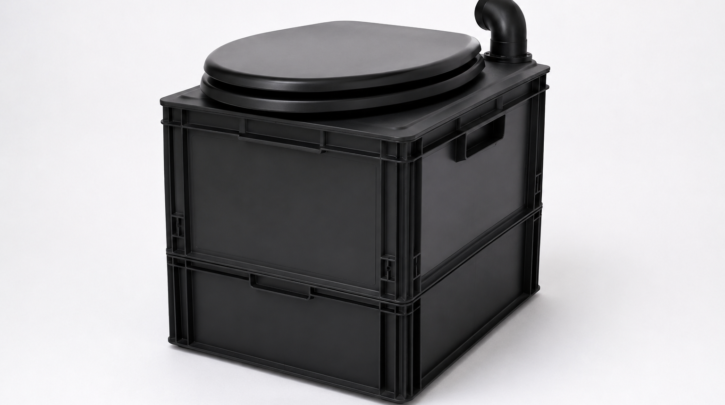

BOXIO markets itself as Europe’s best-selling composting toilet, and its “eurobox” form factor — a straight-walled, stackable design widely used across European camping gear — is genuinely distinctive among the budget portable tier. It’s one of the most-recommended entry points into composting toilets specifically because of its combination of low price and established track record.
Specs at a Glance
| Dimensions | 15.7″L x 11.8″W x 11″H |
|---|---|
| Solids capacity | 8–10 uses; 5-liter separating container |
| Liquids | Leak-proof urine canister |
| Odor medium | Hemp husk (included with starter kits) |
| Power | None required |
| Made in | Rostock, Germany |
| Price | $180–$230 for the toilet alone; bundles run $229–$550+ |
Who Actually Buys This One
BOXIO’s buyer base skews toward exactly the audience its marketing targets: budget-conscious van builders and campers in their first season of trying a composting toilet, boaters who want a stowable option rather than a permanently mounted marine head, and hunters who need something that survives being left in a truck bed or blind between trips without complaint. It’s a notably common recommendation for anyone specifically asking whether composting toilets are worth the switch at all, since the low price makes it a low-risk way to find out.
The Setup Experience
BOXIO’s most consistently praised feature across every review we found is genuinely fast setup — reviewers report going from a packed box to a ready-to-use toilet in under five minutes with no tools of any kind, which matters considerably for a product aimed at people setting up and breaking down camp regularly rather than installing something once. There’s no vent hole to cut, no wiring to run, and no mounting hardware to deal with — you place it, add the hemp husk medium to the solids container, and it’s ready to use.
What It Gets Right
- Genuinely fast setup. Reviewers consistently report full assembly in under five minutes with no tools required, which matters for a product aimed squarely at grab-and-go camping.
- Effective odor control for a non-vented design. The urine diverter combined with a tight-fitting lid and hemp husk medium keeps odor in check without any active ventilation — hemp husk in particular gets specific praise for its absorbency in independent reviews.
- Fits nearly anywhere. Its compact, straight-walled shape fits a bus, boat, car trunk, or garden shed without the awkward angles some competitors have, and it stacks efficiently with other gear for storage or transport.
- Strong track record for its price. Consistently high review scores (4.7–4.9 out of 5 across hundreds of reviews on the manufacturer’s own listings) for a genuinely budget-tier product.
What Comes Up as Complaints
- Low seat height. Multiple reviewers specifically flag the seat as uncomfortably low for some body types, though BOXIO sells an optional booster seat/riser accessory that addresses this directly.
- Urine container handle placement. Some owners report the handle position makes fully emptying the container slightly awkward, though this hasn’t stopped most from recommending the product overall.
- Cleaning the corners. Like other “eurobox”-style straight-walled toilets, the internal grooves and corners take a bit more effort to clean thoroughly than a smoothly molded body would.
BOXIO vs. Its Closest Competitors
Against the OGO Nomad, BOXIO is roughly comparable in price and capacity, with BOXIO’s established track record and wider accessory ecosystem (riser, cushion, bag bundles) as a slight edge, while the Nomad is a few pounds lighter. Against Trelino, reviewers are consistent: BOXIO is the budget pick, Trelino the “nicer” pick with a noticeably higher price — Trelino’s smallest size is the closest direct comparison to BOXIO, and most reviewers who’ve used both describe BOXIO as delivering equivalent core function with fewer refinements. Against Trobolo’s WandaGo, the two sit in a similar price bracket, with Trobolo reviewers often citing a larger solids capacity for the price as its specific edge.
Long-Term Durability
BOXIO doesn’t have the multi-decade track record that Nature’s Head or Air Head can point to, but the sheer volume of positive reviews — hundreds on the manufacturer’s own site alone, plus a strong presence across third-party review sites — suggests reasonable durability for a product built to this price point. The recycled plastic construction and simple, mechanically uncomplicated design (no motor, no agitator, nothing to fail beyond the basic separator itself) work in its favor here, since there’s simply less that can break compared to a more feature-rich unit. The most common wear point reported isn’t structural failure but the urine container’s seal gradually losing its tight fit after repeated use, which is a minor, inexpensive-to-address issue rather than a fundamental durability concern.
The Accessory Ecosystem
BOXIO sells a genuinely useful set of add-ons beyond the base toilet: a riser/storage box that doubles as a step and extra storage, a cushioned seat topper, a toilet-paper holder bag, and bulk bag bundles for solids disposal. None of these are required to use the product, but the riser specifically addresses the most common comfort complaint (low seat height), and it’s worth budgeting for it upfront if you’re ordering based on reviews that mention this issue, rather than treating it as an afterthought purchase later.
Day-to-Day Maintenance
BOXIO’s maintenance routine follows the same general pattern as every non-electric portable unit covered on this site: add hemp husk after each solid use, empty the urine canister roughly daily for one person, and replace the solids bag every 8–10 uses. There’s no fan to check, no vent to inspect, and no agitator mechanism to service — the entire maintenance routine is limited to these three simple, manual steps, which is arguably the product’s biggest practical advantage over any more feature-rich unit for someone who just wants the lowest-maintenance option available.
Value for Money
At $180–$230 for the base unit, BOXIO delivers the same fundamental urine-diversion and carbon-additive principles that justify the price of a $1,000+ premium unit, just without an agitator, active ventilation, or the largest capacity in the category. For anyone weighing whether that gap is worth paying, it’s worth being clear about what you actually get for the extra money on a premium unit: more capacity between empties, hands-free mixing, and active odor control that doesn’t rely entirely on a tight lid and consistent manual habit. If your usage pattern is occasional rather than daily, BOXIO delivers proportionally excellent value; if you’re looking at daily full-time use, the math shifts toward a premium unit fairly quickly.
Who It’s Best For
Budget-conscious campers, boaters, and hunters who want a genuine composting toilet rather than a chemical portable unit, and anyone testing whether the category fits their lifestyle before committing to a pricier self-contained van unit. Its compact, stackable shape also makes it a reasonable pick for a garden shed or workshop bathroom, covered in our backyard sheds guide.
Who Should Look Elsewhere
Full-time van dwellers or anyone needing daily heavy use over months will outgrow BOXIO’s capacity and daily urine-emptying routine quickly — see our van life buying guide for self-contained options built for that load. Anyone specifically bothered by a low seat height should budget for the optional riser accessory from day one rather than discovering the issue after buying.
Verdict
One of the strongest entry points into composting toilets at this price, backed by a genuinely large user base and consistent praise for ease of setup and odor control given its lack of active ventilation. The seat height and cleaning-corners complaints are real but minor relative to the price, and the optional riser accessory resolves the more common of the two.
Related Guides
- Best portable composting toilets for camping
- Best budget composting toilets under $300
- Composting toilet for hunting cabins/blinds
Frequently Asked Questions
Does BOXIO require any tools to assemble?
No — reviewers consistently report full setup in under five minutes with no tools required, one of the product’s most-praised features.
What medium does BOXIO use, and can I substitute something else?
BOXIO uses hemp husk by default, sold in bundles by the manufacturer, though coco coir or sawdust — the same materials covered in our carbon additive comparison — work as substitutes if hemp husk isn’t readily available.
Is the BOXIO booster seat worth buying upfront?
If low seat height is a common complaint among reviewers your size and build resembles, yes — it’s a small additional cost that directly addresses the most-repeated comfort complaint about the product.
Can BOXIO be semi-permanently mounted in a small van or shed?
It’s designed primarily as a portable unit rather than for permanent mounting, though its compact, stable footprint works fine simply set in place for a shed, small boat, or occasional-use van setup without a mounted installation.
How does BOXIO handle very hot or very cold storage between trips?
The recycled plastic construction tolerates a wide temperature range without damage, though it’s worth ensuring both containers are fully empty and dry before storage in either temperature extreme, the same general precaution covered in our maintenance guide’s seasonal care section.
Is BOXIO a good first composting toilet if I’ve never used one before?
Yes — its low price and strong track record make it one of the most commonly recommended starting points for exactly this reason, and its simple manual operation (no agitator, no fan) means there’s less to learn than with a more feature-rich premium unit.