
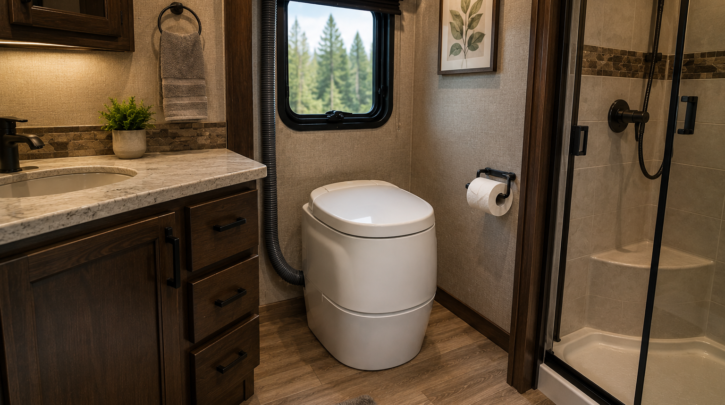

RVs generally give you more bathroom space than a van conversion, and often easier access to both 12V and 110V power — which opens up a couple of options that don’t make as much sense in a tighter, solar-only van build. The right choice here depends heavily on your specific RV’s layout and how you actually travel, more so than in almost any other category on this site.
Top Picks
Nature’s Head — Best Overall for Full-Time RV Living
The standard choice for full-time RVers, and for good reason: a 60–80 use solids capacity, a hand-crank agitator with no motor to fail, and by far the largest base of RV-specific install guides and forum support of any option covered here. Dimensions run approximately 20″W x 21″H x 19″D at 23–28 lbs, which fits comfortably in most standard RV bathroom footprints without requiring layout changes.
Separett Villa — Best for Larger RVs and Fixed Bathrooms
Unlike the fully self-contained units, the Separett Villa drains urine externally through a hose rather than storing it in an onboard bottle — which means far less frequent liquid emptying, but only works if your RV’s layout can actually accommodate that drain line running to an appropriate destination. It handles installations up to 20 feet of hose with up to three 90-degree elbows, runs on both 12V DC and 110V AC, and supports well over 300 lbs. This is a strong pick specifically if your RV bathroom is closer to a small fixed cabin bathroom in layout than to a van’s tight footprint.
OGO Origin — Best for Smaller RVs and Tight Bathroom Layouts
If your RV’s bathroom is on the smaller side — common in Class B and smaller Class C rigs — the OGO’s 16″x15″ footprint and push-button electric agitator make it the easiest small-space option to live with day to day, without sacrificing the convenience of not needing to hand-crank after every use.
CompoCloset Cuddy — Best Budget Pick
At $750–$850 for the full agitator-equipped Cuddy, or $650–$750 for the Cuddy Lite without an agitator, the Cuddy line is the most affordable path into a genuine composting setup for an RV, and its compact dimensions work in most RV layouts without requiring any modification to existing plumbing or cabinetry.
RV-Specific Considerations
A few additional practical details matter specifically for RVs that don’t come up the same way in a van build, largely because RVs vary more widely in construction quality and age than a from-scratch van conversion typically does.
- Power access: RVs more commonly have 110V shore power available than a solar-dependent van, which makes AC/DC-flexible units like the Separett Villa more practical to run continuously than they might be in a battery-only setup.
- Existing black tank plumbing: some RVers route diverted urine into their existing black tank via a drain kit rather than adding a separate bottle — check compatibility with your specific model and drain kit availability before assuming this works out of the box.
- Weight distribution: RVs have stricter cargo weight limits than most people expect going in; factor in the toilet’s weight plus a full solids and liquids load, not just the empty weight listed by the manufacturer, especially if you’re already close to your rig’s rated capacity.
Replacing an Existing Cassette Toilet
Many RVers come to this decision after years of dump-station runs with a cassette toilet, and the good news is that most composting units are sized to fit into the same general footprint a cassette toilet occupied. The meaningful difference is venting: a cassette toilet has no active vent requirement beyond its own sealed tank, while a composting toilet needs a genuine exterior vent hole cut and sealed, plus a 12V circuit for the fan if your chosen model uses one. Budget for this as a proper small project rather than a simple swap — most RVers report a half-day to full day for the conversion, largely driven by how accessible the vent routing is in their specific rig’s construction.
Matching a Model to Your RV Class
RV bathroom footprints vary more by class than most first-time buyers expect, and it’s worth thinking in those terms rather than just comparing toilets in isolation. Class A motorhomes and larger fifth wheels typically have the most generous bathroom space of any RV category, which is exactly where a Separett Villa’s external drain line and larger solids capacity can be installed without the layout gymnastics a smaller rig would require. Class C rigs sit in the middle — usually enough room for a standard Nature’s Head without much trouble, though tighter models may benefit from the OGO’s smaller footprint. Class B camper vans and smaller towable trailers are functionally closer to a van conversion than to a Class A motorhome in terms of available space, and the same compact-footprint logic from our van life guide applies directly.
Common Regrets From RV Owners Who’ve Made the Switch
A few patterns show up repeatedly among RVers who’ve converted from a traditional black-tank toilet to a composting unit. The most common regret isn’t about the toilet itself, but about under-planning the vent installation — RVs often have less accessible wall and floor cavities than a van conversion built from scratch, and retrofitting a vent hole into an already-finished RV interior is a meaningfully bigger job than installing one during new construction. A second common theme is initially underestimating how much more frequent liquids emptying is compared to their old system’s single black-tank dump every several days; several owners specifically mention needing a week or two to adjust their mental model of “toilet maintenance” from an occasional event to a small, frequent habit. Neither issue is a reason to avoid the switch, but both are worth planning around rather than discovering partway through installation.
Resale Value and Trade-In Considerations
If you’re outfitting an RV you might eventually sell rather than keep indefinitely, it’s worth a brief note on how a composting toilet affects resale, since this comes up more often than people expect. A well-known, widely supported brand like Nature’s Head or Separett tends to be viewed as a neutral-to-positive feature by buyers already interested in off-grid or full-time RV living, since it signals the rig is set up for genuine boondocking rather than exclusively hookup-dependent travel. Buyers unfamiliar with composting toilets as a category, on the other hand, sometimes view any non-traditional toilet as a mark against the rig, regardless of brand or quality — worth keeping in mind if you’re planning to sell into a general RV market rather than specifically to the off-grid and van-life-adjacent buyer pool where a composting toilet is more likely to be seen as an upgrade than a compromise.
Financing and Insurance Considerations
A detail that surprises some first-time RV composting toilet buyers: modifying a financed RV’s bathroom, including cutting a new vent hole through the exterior wall, can in rare cases intersect with financing or warranty terms depending on your specific lender and how the RV manufacturer’s warranty is worded. This is far more relevant for a newer, still-financed rig than an older, owned-outright RV, but it’s worth a quick check of your loan and warranty documentation before cutting into the shell of a vehicle you don’t fully own yet, simply to avoid an unpleasant surprise unrelated to the toilet itself.
Related Guides
- Best composting toilets for van life
- Composting toilet vs. cassette toilet
- Maintenance & emptying guide
Frequently Asked Questions
Can I replace my RV’s existing cassette toilet with a composting toilet in the same spot?
Usually yes, though venting requirements differ substantially from a cassette toilet’s setup — you’ll need to add a vent hose and exterior termination point that a cassette toilet never required.
Do composting toilets work in an RV during winter travel?
Yes, though aerobic breakdown slows in cold temperatures. This affects composting speed, not basic function — the toilet still separates and holds waste normally through cold-weather travel, just with slower breakdown until temperatures rise again.
Will a composting toilet reduce how often I need to visit a dump station?
Significantly, yes — liquids still need frequent emptying, but solids stretch to every 3–6 weeks and can often be handled without a dedicated RV dump station at all, depending on local regulations for solids disposal.
Is a composting toilet worth it if I mostly stay at RV parks with full hookups?
Probably not — the main advantage of a composting toilet is freedom from dump station dependence, which matters far less if you’re already staying somewhere with sewer hookups most nights. A traditional RV toilet connected to your existing black tank may simply be the more practical choice in that specific travel pattern.
Does adding a composting toilet affect my RV’s overall water consumption significantly?
Yes, meaningfully — a traditional RV toilet can account for a substantial share of onboard water use during travel, and eliminating that entirely extends how long a given fresh water tank lasts between fill-ups, which matters most for RVers who boondock away from easy water access rather than staying at full-hookup sites where this benefit is less relevant.