
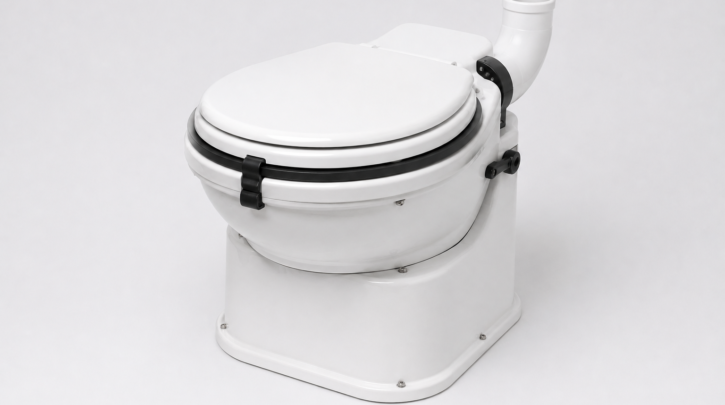

Air Head has been on the market since 2001 and has built its reputation on configurability — seat style, crank side, and urine tank size can all be chosen to fit an unusually shaped install, which is rarer than it should be in this category, where most competitors ship in a single fixed configuration.
Specs at a Glance
| Dimensions | ~18.75″W x 19.75″H x 19″D (standard); smaller marine-seat variant available |
|---|---|
| Weight | 18.75–29 lbs depending on configuration |
| Solids capacity | Up to 80 uses (5-gallon tank) |
| Urine tank | 3L or 7L options |
| Fan | 12V / 60mA / 0.72W |
| Warranty | 5 years |
| Price | Approx. $1,000–$1,100 (typically the priciest of the mainstream options) |
Who Actually Buys This One
Air Head’s configurability draws a specific buyer profile: sailors and liveaboards with a genuinely odd-shaped marine head where a fixed-configuration competitor simply won’t fit, and RV or boat owners retrofitting into an existing bathroom footprint that was designed around a different toilet entirely. It’s a less common default choice for a from-scratch van build, where the bathroom is being planned around the toilet rather than the other way around, and where OGO or CompoCloset Cuddy’s smaller fixed footprints often win out on price and simplicity instead. It’s also worth noting that a meaningful share of Air Head’s customer base has owned a previous unit and is specifically replacing an aging one rather than buying into the category for the first time — a signal of genuine long-term satisfaction among its existing owner base that’s harder to find data on for newer competitors.
What It Gets Right
- Genuinely configurable. Choice of seat type, which side the crank sits on, and urine tank size lets you fit installs that would be awkward or impossible with a fixed-configuration competitor.
- Rubber-sealed lid and seat specifically designed with wet-bath and shower-adjacent marine installs in mind — a design priority that sets it apart from most van-oriented competitors.
- High solids capacity relative to its footprint — up to 80 uses is on par with Nature’s Head despite a smaller overall size in some configurations, which is a genuinely strong capacity-to-footprint ratio.
- Long track record — over two decades in the marine and RV market with continuous refinement, giving it a durability history second only to Separett among the brands covered on this site.
What Comes Up as Complaints
- Urine tank viewing window is hard to read. Multiple long-term owners specifically note it’s more opaque and harder to gauge at a glance than Nature’s Head’s or OGO’s level indication, leading to occasional overflow surprises that catch even experienced owners off guard.
- Agitator isn’t removable on standard configurations, unlike CompoCloset’s Cuddy Lite, which limits flexibility if your needs or usage pattern change over time.
- Highest price point among the mainstream options covered here — typically about $50–100 more than Nature’s Head for broadly comparable capacity.
The Installation Experience
Air Head’s configurability genuinely shows up during installation, not just on a spec sheet — being able to specify which side the crank sits on and which seat style fits your space means fewer compromises than a fixed-configuration unit would force in an odd bathroom layout. The tradeoff is that this flexibility comes with more decisions to make before you order, and it’s worth measuring your specific install carefully and consulting Air Head’s configuration options directly rather than assuming a single standard footprint applies. The roughly 48mm vent hose and 12V fan wiring follow the same general installation principles as other brands, covered in our van installation guide.
Long-Term Durability
Over two decades of continuous refinement gives Air Head a durability track record that’s genuinely competitive with Nature’s Head, and the stainless steel hardware and rubber-sealed construction hold up well in the marine environments the brand was specifically designed around — arguably a tougher long-term durability test than most van or RV use. The main recurring long-term issue isn’t structural but usability-related: the opaque urine tank viewing window doesn’t improve with age, and owners who’ve had the unit for years still report the same difficulty gauging fill level that newer owners mention, suggesting it’s a design characteristic rather than something that degrades further over time.
Who It’s Best For
Boat and marine installs specifically, where the rubber-sealed wet-bath design is a genuine advantage, and any install with an unusually shaped space where configurable seat, tank, and crank options solve a fit problem other brands genuinely can’t.
Who Should Look Elsewhere
If tracking your urine tank fill level at a glance matters to you, Nature’s Head or OGO’s clearer indicators are less prone to overflow surprises. Budget-conscious buyers will also find better value-per-dollar in the CompoCloset Cuddy line for broadly comparable functionality without paying a premium for configurability they may not need.
Verdict
A strong, proven option specifically for marine and oddly-shaped installs where its configurability earns its premium price — less competitive on pure value against Nature’s Head or CompoCloset Cuddy if your install doesn’t actually need that flexibility in the first place.
Common Repairs and Replacement Parts
Given its two-decade market history, Air Head has an established parts supply chain directly through the manufacturer, and the fan remains the most commonly replaced component, consistent with the pattern across every brand covered here. The rubber seals around the lid and seat — a key part of the marine-oriented design — are worth inspecting more frequently than on van-oriented competitors, simply because they’re doing more work in a wet-bath or marine environment and are more exposed to the kind of moisture and UV exposure that degrades rubber over time.
How It Stacks Up Against the Rest of the Field
Against Nature’s Head, Air Head wins on configurability and marine-specific sealing but loses on the urine tank visibility complaint and costs slightly more for broadly similar capacity. Against OGO and CompoCloset Cuddy, it loses on price and footprint but wins for anyone whose install genuinely needs a non-standard seat, crank side, or tank size — a need those fixed-configuration competitors simply can’t accommodate regardless of price.
Configuration Decision Guide
Given how many configuration choices Air Head offers, a simple decision framework helps narrow things down faster than working through every option from scratch. If you’re installing in a genuinely wet environment — a shower-adjacent head or an open-plan marine bathroom — the marine seat is the right starting point. If floor space is your primary constraint, pair that marine seat with the smaller 3-liter tank to minimize footprint, accepting more frequent liquid emptying in exchange. If capacity matters more than footprint, the larger 7-liter tank with the standard seat is the better default, and crank side should simply follow whichever side of your installed unit has clear access given your specific cabinetry or wall layout.
Related Guides
- Best composting toilets for boats/marine use
- Best composting toilets for van life
- Small/compact composting toilets for tight spaces
What to Confirm Before Ordering
Because Air Head sells configuration as its central differentiator, take the time to actually measure your specific install and work through the seat, crank-side, and tank-size options directly with the manufacturer before ordering, rather than defaulting to whatever configuration looks standard. Given the urine tank viewing window complaint that comes up so consistently, it’s also worth asking specifically about the clearest current viewing window option available, since minor design refinements across the brand’s two-decade history mean this detail may have improved on newer production runs compared to older reviews you might come across.
Frequently Asked Questions
Can I choose which side the Air Head’s crank sits on?
Yes — this is one of the model’s specific configuration options, useful for fitting the toilet against a wall or cabinet on either side without compromising crank access.
Is the Air Head a good fit for a boat?
Yes — its rubber-sealed lid and seat design and marine-seat option were built specifically with wet-bath and boat installs in mind, and it has one of the longest track records of any brand in the marine market specifically.
What’s the real difference between the 3L and 7L urine tank options?
The smaller 3L tank reduces the unit’s footprint for tight installs but requires more frequent emptying; the 7L tank stretches time between empties at the cost of a slightly larger footprint and additional weight.
Are replacement parts easy to find for an older Air Head unit?
Generally yes — given the brand’s two-decade history, most wear parts like fans, seals, and gaskets remain available directly from the manufacturer, though it’s worth confirming compatibility with your specific unit’s age and configuration before ordering, since details have evolved over the years.
Does the marine configuration cost more than the standard version?
Pricing between configurations is generally similar, since the differences are mostly in seat style and tank size rather than added materials or complexity — confirm current pricing for your specific chosen combination directly, since exact figures can shift between configuration options more than the base price alone suggests.