
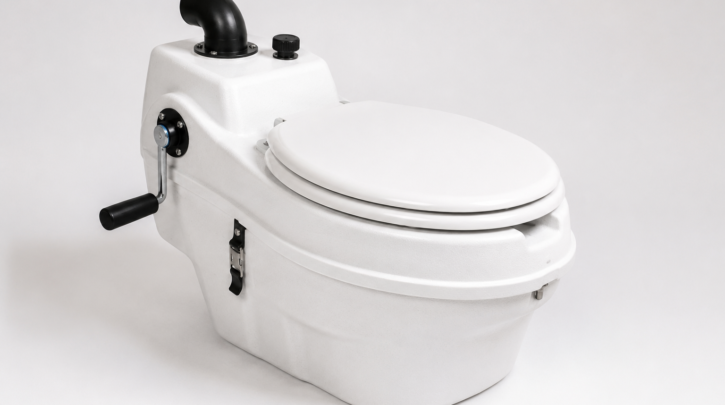

Nature’s Head is the option most people land on first when they start researching composting toilets, and it’s held that position in the van, boat, and off-grid community for close to two decades. That popularity is well-earned, but it’s also worth knowing what the recurring complaints actually are before you commit roughly $1,000 to one — a review that only lists what’s good isn’t actually helping you decide.
Specs at a Glance
| Dimensions | Approx. 20″W x 21″H x 19″D (varies up to ~4% by unit) |
|---|---|
| Weight | 23–28 lbs empty (varies by handle/config) |
| Solids capacity | 60–80 uses before emptying |
| Urine bottle | 2.2 gallons |
| Power draw | Fan: 1.68A over 24 hrs at 12V |
| Vent hose | 1-1/4″ PVC, 5′ included, extendable |
| Warranty | 5 years |
| Price | Approx. $960–$1,095 (check current price) |
Who Actually Buys This One
Nature’s Head skews toward buyers who want the option with the longest track record rather than the newest features — full-time van dwellers who’ve read enough forum threads to know exactly what they’re getting, sailors who value a hand-crank design with nothing electronic to fail at sea, and cabin owners who’d rather buy the proven default than gamble on a newer competitor’s first few years on the market. It’s less often the choice of someone specifically optimizing for the smallest possible footprint or the most modern-looking appliance in their bathroom — those buyers tend to end up with OGO or CompoCloset Cuddy instead, as covered in our van life buying guide.
What It Gets Right
- Hand-crank agitator, no motor to fail. Unlike electric-agitator competitors, there’s no motor that can burn out — the crank either works or it doesn’t, and there’s nothing to replace beyond simple mechanical parts that are trivial to source or improvise in the field.
- By far the largest support ecosystem. More installation guides, forum threads, and third-party parts exist for Nature’s Head than for any competitor, which matters considerably when you’re troubleshooting a first install with no prior experience.
- Genuinely odor-free when used correctly. Reviewers consistently report zero odor complaints from guests once the unit is dialed in, which is the single most repeated praise across long-term ownership reviews.
- Made in the USA with stainless steel hardware that holds up well to years of mobile use over rough roads and marine conditions alike.
What Comes Up as Complaints
- Urine crossing into the solids chamber. This is the single most-repeated complaint across long-term owner reviews, and it’s almost always a sitting-position issue rather than a hardware defect — Nature’s Head publishes seating guidance specifically to address it, and it disproportionately affects smaller-framed users.
- Hard-to-reach crevices during cleaning. The molded shape has a few corners that take more effort to wipe down than a flat-sided design like the Cuddy’s.
- Doesn’t arrive fully ready to use. Owners are frequently surprised to learn the 110V power adapter and certain vent covers are sold separately from the base unit — budget for these before you buy, not after, or your first weekend with the unit will involve an unplanned parts order.
- Tall for shorter users. Several reviewers note needing to add a small step or platform, especially in boat installs where the mounting height compounds with a shorter cabin ceiling.
The Installation Experience
Because Nature’s Head has been on the market longer than any self-contained competitor, the install experience benefits from over a decade of accumulated community knowledge — nearly every conceivable installation scenario, from a Sprinter van to a sailboat’s cramped head, has been documented somewhere by a previous owner. This matters more than it might seem: a first-time installer working through an unusual mounting challenge is far more likely to find a relevant existing walkthrough for Nature’s Head than for a newer competitor with a smaller community. The unit itself mounts through four points into a subfloor or platform, uses a 1-1/4″ PVC vent connection that’s compatible with standard hardware-store fittings if you need to extend the run, and the whole process typically takes a half-day to a full day for a first-time installer, consistent with the general installation guidance we cover in our van installation guide.
Long-Term Durability
This is where Nature’s Head’s longer track record genuinely pays off in terms of confidence: with close to two decades of units in continuous field use, there’s a substantial base of multi-year ownership reports to draw on, and the pattern that emerges is reassuring. The stainless steel hardware holds up well against corrosion even in marine environments, the molded polyethylene housing resists cracking under the kind of vibration a van or boat regularly produces, and the simplest mechanical parts — the hand crank and the hinges — have few failure modes reported even after years of daily use. The fan is the component most likely to eventually need replacement, consistent with any 12V computer-style fan’s typical service life, and it’s inexpensive and simple to swap.
Who It’s Best For
Full-time van, RV, and boat dwellers who want the most field-proven option and don’t mind a slightly larger footprint than the newest compact competitors. If you want the mechanism with the fewest possible points of failure, the hand-crank design is a genuine advantage over electric-agitator alternatives, particularly for anyone traveling somewhere a replacement part might take days to arrive.
Who Should Look Elsewhere
If floor space is extremely tight, the OGO Origin or CompoCloset Cuddy have meaningfully smaller footprints — see our small/compact composting toilets guide for exact measurements. If you’re prone to urine-crossing issues due to build or height, it’s worth reading seating guidance carefully before buying, or considering a urine-diverting design like Separett’s external-drain approach instead, which removes the failure mode entirely by design rather than relying on correct seating technique.
Verdict
Still the safest first purchase in this category for most people — not because it’s flawless, but because its failure modes are well-documented and its support ecosystem is unmatched. Budget for the power adapter and vent kit as separate line items, and read the seating guidance before your first use rather than troubleshooting an avoidable problem after the fact.
Common Repairs and Replacement Parts
Because of its long market history, Nature’s Head has the most mature replacement parts ecosystem of any brand covered on this site, including third-party compatible parts beyond just what the manufacturer sells directly. The fan is the most commonly replaced component, consistent with any 12V fan’s typical service life, and swaps in without specialized tools in most reported cases. Gaskets and seals are the second most common replacement, generally recommended at the first sign of cracking rather than waiting for an active leak. The hand crank mechanism itself is rarely reported as failing outright, though the plastic gearing inside can wear over many years of heavy use — a slow degradation rather than a sudden failure, which gives owners time to plan a repair rather than being caught without a working toilet.
How It Stacks Up Against the Rest of the Field
Against OGO and Air Head specifically, Nature’s Head wins on mechanical simplicity and community support but loses on footprint — it’s larger than either. Against Separett Villa, it wins on installation simplicity and manual-fallback reliability but loses on the no-bottle convenience Separett’s external drain design offers. Against CompoCloset Cuddy, it wins on solids capacity and track record but loses decisively on price. None of these are universal wins or losses — they’re tradeoffs that map onto different priorities, which is exactly why we don’t declare a single “best overall” winner across this entire product category and instead point buyers toward whichever model’s strengths match their specific constraints, as covered across our full van life buying guide.
Related Guides
Frequently Asked Questions
Does the Nature’s Head come with everything needed for installation?
No — the base unit includes a standard vent hose and hardware, but the 110V AC power adapter and certain vent cap styles are sold as separate accessories. Check your specific kit’s contents before assuming otherwise.
How often do most owners empty the solids bin?
Most full-time users report emptying every 3–4 weeks, though this varies with carbon additive use and number of users, consistent with the general 3–6 week range covered in our maintenance guide.
Is the Weekender variant worth it over the standard model?
The Weekender trades some solids capacity for a smaller, lighter (20 lb) footprint — worth it if floor space or payload weight is your binding constraint, less so if capacity matters more to you than saving a few inches and pounds.
How does the seating guidance for preventing urine crossover actually work in practice?
The core guidance is to sit further forward than habit might suggest on a standard toilet, since the diverter is positioned to catch liquid at the front of the bowl. Most owners report this becomes automatic within the first week of regular use, and it’s worth explaining to any guests before their first use rather than letting them learn by trial and error.