
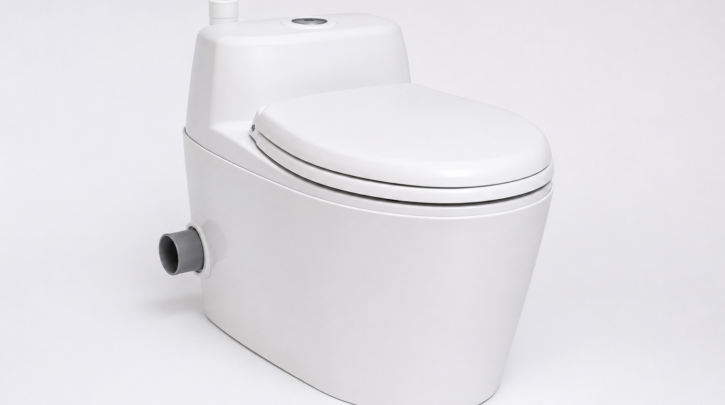

Separett has been building waterless toilet systems since 1976, and the Villa (formerly branded Villa 9215) is their flagship urine-diverting model for cabins, tiny homes, and larger RVs. Its defining difference from Nature’s Head and most competitors: urine drains externally through a hose rather than collecting in an onboard bottle, which changes the day-to-day ownership experience more than any single spec on the sheet suggests.
Specs at a Glance
| Dimensions | 18″W x 26.5″L x 21.3″H |
|---|---|
| Solids container | 6 gallons |
| Urine handling | External drain line (no onboard bottle) — to a drain, leaching bed, holding tank, or fertilizer diverter |
| Power | 110–240V AC or 12V DC (solar/battery compatible) |
| Fan draw | 0.06 kWh / 24h |
| Max vent run | Up to 20 ft with up to three 90° elbows |
| Weight capacity | Over 300 lbs (sources vary between 330-440 lbs) |
| Warranty | 5 years on the unit, 3 years on the fan |
| Price | Check current price — typically positioned above Nature’s Head |
Who Actually Buys This One
The Villa’s buyer profile skews heavily toward fixed or semi-fixed installations rather than vehicles built from scratch: cabin owners retrofitting an existing structure, tiny home builders who’ve planned the plumbing chase during design, and larger RV owners with a bathroom substantial enough to accommodate a drain line rather than a self-contained bottle. It’s a notably less common choice for a van conversion specifically, not because it wouldn’t function, but because most van layouts don’t have an obvious place to route an external urine drain without significant extra plumbing work that a self-contained bottle-based unit avoids entirely.
What It Gets Right
- No urine bottle to carry and dump. Because liquids drain externally, you skip the daily bottle-emptying routine that self-contained units require — a genuine quality-of-life win if your installation supports a drain line, and consistently the single most-praised feature across owner reviews.
- No additives strictly required for basic operation, which simplifies day-to-day use compared to models that need consistent carbon additive management after every single use.
- Biodegradable bag system makes solids emptying notably easier than hand-cranking a bin, according to repeated owner feedback — you’re tying off and lifting out a bag rather than scooping loose material.
- Flexible power options — genuinely useful for installations that might move between shore power and battery/solar, and the fan’s very low draw (0.06 kWh/24h) makes continuous 12V operation realistic even on a modest solar setup.
What Comes Up as Complaints
- Requires power to function at all. Unlike Nature’s Head’s hand-crank design, there’s no fully manual fallback — a power outage or dead battery leaves the unit non-functional until power is restored, which is a real consideration for anyone whose power system isn’t rock-solid.
- Higher upfront cost than most self-contained competitors, reflecting its more involved drain-based design and established brand history.
- Needs an external drain line for the urine-diversion benefit to fully pay off — this makes it a poor fit for a van conversion without a place to route that line, and a strong fit for a fixed cabin or larger RV installation with more plumbing flexibility.
- Solids capacity, while generous, isn’t unlimited — busy multi-user households still need to empty on a regular schedule, and the 6-gallon container fills faster with more frequent daily use than a single-occupant cabin would produce.
The Installation Experience
Installing a Separett Villa is a genuinely different scope of project than installing a self-contained unit, and it’s worth going in with accurate expectations. Beyond the standard vent hose connection every composting toilet needs, you’re also planning and running an external urine drain line to its final destination — a drain field, leaching bed, or holding tank — which requires more upfront planning than simply mounting a self-contained box. For a cabin build where this plumbing is being planned alongside the rest of the structure, it’s a manageable addition to the overall project. For a retrofit into an already-finished space, it’s a meaningfully bigger job, and it’s worth budgeting real time for planning the drain route before you even open the box.
Long-Term Durability
Separett’s decades-long history in the waterless toilet market — considerably longer than Nature’s Head’s — shows up in a mature, refined product with few reported structural issues over years of use. The fan’s separate three-year warranty specifically (shorter than the unit’s own five-year coverage) reflects the fact that it’s the one component most likely to eventually need attention, consistent with the general pattern across every brand covered on this site: fans wear faster than housings, hardware, or seals. Owners running the unit continuously off 12V solar power for years report no unusual degradation tied specifically to that power mode, which is reassuring for anyone planning a fully off-grid cabin installation.
Who It’s Best For
Cabins, tiny homes, and larger RVs with a place to route an external urine drain line. The Villa shines specifically in fixed or semi-fixed installations where you’re not fighting for every cubic inch and can commit to a proper drain routing during install, letting its no-bottle design deliver its full quality-of-life benefit.
Who Should Look Elsewhere
Van conversions without room for an external drain line will lose the model’s biggest advantage — a self-contained option like Nature’s Head, OGO, or CompoCloset Cuddy makes more sense there, as covered in our van life buying guide. If you need a toilet that works during a power outage without any workaround, the hand-crank Nature’s Head is the safer choice by design.
Verdict
The strongest pick in this comparison set for a genuinely fixed installation — cabin, tiny home, or a larger RV with room to plumb a drain line. Its dependence on continuous power is the one tradeoff worth taking seriously before you buy, and it’s a tradeoff that matters far less if your power system is already reliable.
Common Repairs and Replacement Parts
The fan is again the component most likely to eventually need replacement, and Separett’s separate three-year fan warranty (versus five years for the rest of the unit) reflects that expectation directly. Beyond the fan, the drain line and its fittings are worth periodic inspection specifically because they’re the one part of this system genuinely different from every self-contained competitor — a slow drain line clog or a degraded fitting seal is a Separett-specific maintenance item that a Nature’s Head or OGO owner simply never has to think about, precisely because those units keep everything onboard rather than routing to an external destination.
How It Stacks Up Against the Rest of the Field
Against Nature’s Head, the Villa wins decisively on eliminating the urine bottle chore but loses on power independence and van-friendliness. Against OGO and CompoCloset Cuddy, it wins on solids capacity and simplified additive-free operation but loses badly on footprint and installation complexity — neither of those compact, van-first designs is a realistic drain-line candidate. Against Air Head, the comparison is closer to apples-to-oranges, since Air Head’s configurability serves a completely different installation problem than Separett’s drain-based design solves. The right comparison, in short, depends entirely on whether your specific space can support an external drain line at all.
Related Guides
- Separett Villa vs. Nature’s Head
- Best composting toilets for cabins
- Separett Villa 9215 full review (fixed installation)
What to Confirm Before Ordering
Because the Villa’s core advantage depends entirely on having somewhere appropriate to route the urine drain line, it’s worth confirming this specific detail before placing an order rather than discovering a limitation partway through installation. Check local regulations for where diverted urine can legally drain — requirements vary meaningfully by jurisdiction, particularly for anything routing toward groundwater — and confirm your planned drain run doesn’t exceed the unit’s practical length limits for maintaining reliable flow. If you’re retrofitting into an existing cabin rather than building new, it’s also worth a walk-through with anyone doing the plumbing work to confirm the route is actually feasible given existing floor joists, insulation, and any other systems already in place.
Frequently Asked Questions
Can the Separett Villa run entirely off-grid?
Yes — its 12V DC mode is designed for solar or battery power, with very low fan draw (0.06 kWh/24h), making it genuinely viable for off-grid setups as long as some power source is maintained continuously.
Do I need to add carbon additive like sawdust or coco coir?
Not strictly required for basic operation, though some owners add a small amount to help manage moisture in especially humid climates, similar to the general guidance in our carbon additive comparison.
What happens to the diverted urine?
It routes through an external drain line to a drain field, leaching bed, holding tank, or — with an optional accessory — a diverter for use as diluted fertilizer, following the safety guidance in our fertilizer use guide.
How does the Separett Villa compare in ongoing cost to a self-contained unit?
Ongoing costs are lower than most self-contained competitors since carbon additive isn’t strictly required for daily operation, though the higher upfront price and installation complexity mean the total cost advantage mostly shows up over several years of ownership rather than immediately.