
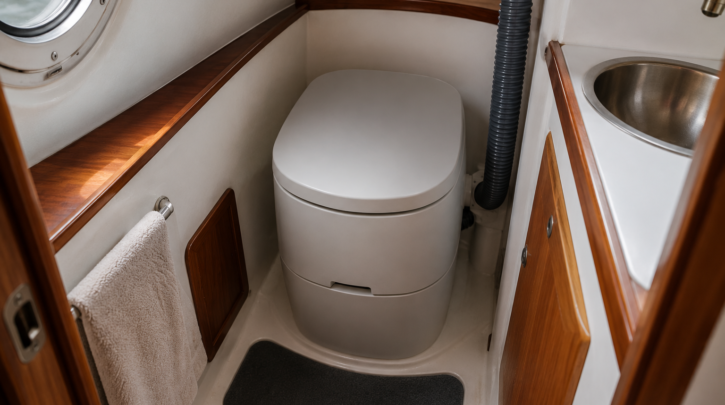

When every inch of floor space is accounted for — a wet bath, a truck camper, a sailboat head — footprint becomes the deciding factor before anything else, often before you even get to comparing capacity or price. Here’s how the smallest current options actually stack up against each other, and what you give up to get there.
Footprint Comparison
The table below lists exact manufacturer dimensions side by side so you can compare against your own measured space directly, rather than relying on marketing language like “compact” or “space-saving” that different brands apply somewhat inconsistently to genuinely different sizes.
| Model | Width | Depth | Height | Weight |
|---|---|---|---|---|
| OGO Origin | 16″ | 15″ | 18.375″ | ~29 lbs |
| CompoCloset Cuddy | 15.1″ | 16.8″ | 16.3″ | ~24 lbs |
| Nature’s Head Weekender | 18″ | 18″ | 16.75″ | 20 lbs |
| Air Head (marine seat, small tank) | 18.75″ | 17.5″ | 19.75″ | ~18.75 lbs |
| Nature’s Head (standard) | 20″ | 19″ | 21″ | 23–28 lbs |
Smallest Overall Footprint: OGO Origin and CompoCloset Cuddy
These two are effectively tied for the smallest floor footprint among units that still include a real composting mechanism — an agitator or mixing system, not just a bag-and-bin approach. OGO edges narrower; Cuddy edges shallower — which one actually fits better depends on the exact shape of your available space rather than either being definitively smaller across every dimension. If your constraint is width specifically, measure carefully, since the difference between them is small enough that it genuinely comes down to your particular floor plan.
Best for Wet Baths: Air Head (Marine Configuration)
Air Head’s marine seat option with the smaller 3-liter urine tank drops both depth and weight further than its standard configuration, and the brand’s rubber gasket sealing was specifically designed with wet-bath and shower-adjacent installs in mind — a genuinely different design priority than the other models on this list, most of which weren’t built with direct water exposure as a primary consideration.
Best Lightweight, No-Frills Option: Nature’s Head Weekender
At just 20 lbs and a shallower footprint than the standard Nature’s Head, the Weekender variant trades some solids capacity for a meaningfully smaller and lighter package — a solid choice for smaller van conversions or truck campers where every pound matters for payload, and where the reduced capacity is an acceptable tradeoff because the build is intended for occasional rather than full-time use.
What You Give Up at This Size
- Solids capacity — compact units generally hold fewer uses between empties than full-size models like the standard Nature’s Head or Separett Villa, which means a more frequent maintenance routine that’s worth factoring into your decision, not just the footprint itself
- Hand access room — a tight footprint often means less room to comfortably reach in during emptying; check clearance on at least one side before assuming a listed footprint tells the whole story
- Urine tank size — smaller footprints usually mean smaller liquid capacity, which translates directly into more frequent emptying trips, particularly noticeable for two full-time users sharing one unit
Measuring Before You Buy
Manufacturer dimensions are for the toilet body alone — always add clearance for the lid to open fully, room to lift out the solids bin vertically, and space to access the liquids container without needing to unmount anything first. A model that “fits” on paper can still be genuinely unpleasant to actually empty in practice if you haven’t checked these secondary clearances, and this is one of the most common regrets we hear from first-time buyers who measured only the base footprint listed on a spec sheet.
When a Compact Unit Isn’t the Right Tradeoff
It’s worth being honest that footprint isn’t always the constraint that should win. If your available space is merely tight rather than genuinely extreme — say, you could fit a standard Nature’s Head with careful planning, but it would require rearranging a shelf or adjusting a cabinet door swing — it’s worth weighing that modest inconvenience against months or years of more frequent emptying with a smaller-capacity unit. Compact models earn their place specifically when the alternative genuinely doesn’t fit at all, not merely when it would require some minor accommodation elsewhere in the build.
Marine-Specific Considerations Beyond Footprint
Boat installs face a couple of constraints that don’t apply the same way in a van, and they’re worth factoring in alongside pure footprint. Motion at anchor or underway means gasket quality and secure latching matter more than in a stationary or lightly-moving vehicle install, which is part of why Air Head’s marine-specific seals and mounting hardware are frequently cited by liveaboard sailors as worth the premium over a generic van-oriented unit. Salt air and humidity also accelerate corrosion on any hardware that isn’t specifically rated for marine environments, so it’s worth checking whether a given unit’s screws, hinges, and fan housing are marine-grade before installing in a boat rather than assuming a van-rated unit performs identically at sea.
What Compact-Unit Owners Actually Report
Across long-term reviews of the smallest units on this list, a consistent theme emerges: owners who chose a compact model because their space genuinely required it report high satisfaction, while owners who chose one purely to “save space” when a larger unit would have fit with minor adjustment more often mention wishing they’d gone bigger for the reduced emptying frequency. This isn’t a knock on any specific compact model’s build quality — it’s a reminder that the tradeoff described above in “What You Give Up at This Size” plays out in real ownership experience, not just in theory, and it’s worth taking seriously during the decision rather than after moving in.
Truck Camper and Slide-In Camper Specific Notes
Truck campers and slide-in units add their own wrinkle beyond what a van or standard RV bathroom faces: total vehicle weight capacity is often the binding constraint, not just floor footprint. A slide-in camper riding on a pickup’s bed has a hard payload ceiling set by the truck itself, and every pound saved by choosing a lighter compact toilet — the Nature’s Head Weekender’s 20 lbs versus the standard unit’s 23–28 lbs, for instance — genuinely competes with water, propane, and personal gear for that same weight budget in a way that matters more here than in a purpose-built van conversion with generous payload margin. It’s worth weighing this alongside footprint specifically for this vehicle category, since the smallest option by floor space isn’t always the lightest option by weight, and for a truck camper build, weight can be the more binding constraint of the two.
Custom and Modified Units for Extremely Tight Spaces
In genuinely extreme cases — a footprint smaller than any of the models covered above can accommodate — some owners pursue a custom or semi-custom build rather than a manufactured self-contained unit at all, essentially applying the same urine-diversion and carbon-additive principles from our DIY composting toilet guide to a bucket or bin sized precisely to an odd space a manufactured unit simply won’t fit into. This trades away the convenience of a manufactured product’s agitator and integrated fan for total dimensional flexibility, and it’s worth considering only after confirming that every option in the comparison table above has genuinely been ruled out by measurement, not just assumed to be too big.
Related Guides
- Best composting toilets for van life
- Composting toilet installation in a van
- Maintenance & emptying guide
Frequently Asked Questions
Is a smaller composting toilet always the right choice for a small van?
Not necessarily — a compact unit with a small solids bin means more frequent emptying, which can be a bigger day-to-day hassle than a slightly larger footprint for full-time living. Weigh capacity against space honestly rather than defaulting to “smallest available.”
Do compact models sacrifice odor control compared to full-size units?
No — odor control comes down to urine diversion, carbon additive, and ventilation, all of which are present in the compact models listed here just as much as in full-size units. Footprint and odor performance are largely independent factors.
Which compact model is easiest to empty in a tight bathroom?
The CompoCloset Cuddy’s front-accessible agitator handle and top-loading design are frequently cited by van builders as easier to service without needing to remove the unit from its mount, compared to side-crank designs that need clearance on a specific side.
Is it worth building custom cabinetry around a compact unit to save even more space?
It can be, but leave real access room for lid clearance and bin removal in your design — a tightly custom-built enclosure that doesn’t account for these can turn routine maintenance into a genuinely frustrating task, undoing much of the space savings you were trying to achieve.
Do any of these compact models support a manual, non-electric fallback if the fan fails?
Not directly for active ventilation, though a temporarily propped-open lid combined with more generous carbon additive use can reduce odor risk for a short period while you source a replacement fan, which are generally inexpensive and simple to swap in across all of the models covered here.