
“Off-grid” covers a wide range of actual situations — a cabin with solar and battery backup is a very different power reality than a homestead with no electrical system at all. The right composting toilet depends heavily on which of those you actually are, more than in almost any other buying decision on this site.
If You Have Reliable Solar or Battery Power
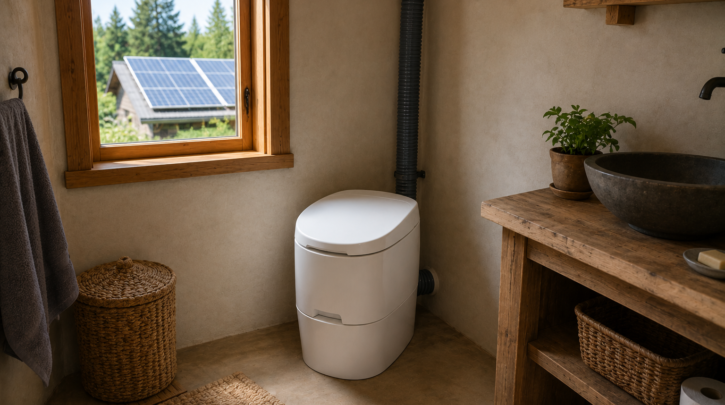
This category covers the large majority of genuinely off-grid homes we hear from, since most off-grid builders invest in at least a basic solar and battery setup before moving in full-time, even if it’s modest compared to a grid-tied home’s essentially unlimited power access.
A modest solar setup with battery storage opens up nearly every option covered on this site. The Separett Villa’s 12V DC mode draws just 0.06 kWh per 24 hours — trivial for almost any solar system sized for basic off-grid living — and its external drain design removes the daily bottle-emptying chore many self-contained units require. The Sun-Mar Excel’s standard electric heater-and-fan design also works well here, provided your power system can handle its roughly 125-watt average draw continuously rather than in short bursts.
If You Have No Reliable Power at All
This is a genuinely different design requirement, and it narrows the field considerably. The Sun-Mar Excel NE is purpose-built for exactly this situation — its three-chamber design uses passive convection through a 4″ vent rather than a powered fan or heater, functioning like a wood stove’s chimney rather than an electric appliance. Nature’s Head is also a strong option here, since its hand-crank agitator needs no power at all, though its fan does benefit from at least an intermittent 12V source for best odor control — it’s designed to run on 12V but the core mechanical function doesn’t depend on it.
If You’re Supporting a Full Household Long-Term
Full-time off-grid households with multiple people put considerably more demand on a composting toilet than a weekend cabin does, and capacity becomes the dominant factor. The Sun-Mar Excel’s 3-adult residential rating is the highest sustained-capacity self-contained option covered here; households larger than that should look into central/batch composting systems, covered in more depth in our upcoming two-chamber batch systems guide, which handle higher volumes by separating the toilet fixture from a larger, separate composting chamber.
Quick Comparison
| Model | Power Requirement | Capacity | Best For |
|---|---|---|---|
| Sun-Mar Excel NE | None (passive vent; optional 1.4W fan) | 3 adults residential / 6-8 weekend | Zero reliable power, high capacity |
| Nature’s Head | 12V fan (benefits from power, not dependent on it for core function) | 60–80 uses | Minimal power, simple mechanism |
| Separett Villa | 12V DC or 110-240V AC (very low draw) | 6-gallon solids container | Reliable solar/battery, no bottle emptying |
| Sun-Mar Excel | 110V AC, ~125W average | 3 adults residential / 6-8 weekend | Reliable grid or robust solar/generator power |
Water Independence as Part of the Bigger Picture
For a genuinely off-grid property, water independence often matters as much as power independence, and a composting toilet contributes meaningfully here in a way that’s easy to overlook when comparing models purely on capacity and price. Eliminating toilet flushing removes what would otherwise be one of the largest single water draws in a typical household, which matters considerably more when your water comes from a well with limited output or from hauled/collected sources rather than a municipal supply with effectively unlimited capacity. This is part of why composting toilets show up so consistently on off-grid homestead sites specifically, beyond just the septic-avoidance angle covered in our vs. septic comparison.
Common Mistakes When Planning an Off-Grid Sanitation System
A few patterns show up repeatedly among people building out off-grid sanitation for the first time. The most common is underestimating how much the emptying routine changes with real household size — a composting toilet rated for “3 adults residential use” doesn’t mean effortless operation at that capacity, it means the unit can handle that load without failing, while still requiring real, regular attention. The second is assuming a non-electric option is automatically the right choice for any off-grid situation, when in practice a reliable solar setup with even modest battery storage often makes an electric-assisted unit’s more active moisture management genuinely worth the small added power draw. The third is failing to plan greywater handling alongside the toilet decision — a composting toilet solves one piece of a property’s wastewater picture, not the whole thing, and skipping that planning is a common reason off-grid builds run into permitting problems later.
Legal Considerations for Off-Grid Homes Specifically
A permanent off-grid home is treated very differently under most local codes than a vehicle installation, and this is where getting the legal side wrong can cause real problems — some jurisdictions have specifically restrictive rules around composting toilets as a primary or sole sanitation system, separate from their rules for vacation cabins or accessory structures. NSF/ANSI 41 certification is close to universally required at minimum, but requirements around liquid waste handling, required greywater systems, and whether a composting toilet can be your only bathroom fixture at all vary meaningfully by state and county. See our full legal requirements and permits by state guide before committing to a fully off-grid sanitation plan, and confirm directly with your local health department rather than relying solely on general guidance — this is one area where the specifics genuinely matter for whether your home passes inspection.
Planning for Growth Over Time
Off-grid households often grow — more family members, more frequent guests, or simply a shift from part-time to full-time occupancy — in ways that a van build rarely needs to accommodate. It’s worth thinking about this during your initial planning rather than treating your first purchase as permanent. A self-contained unit that’s comfortable for two people can become a genuine bottleneck for four, and the cost of upgrading later (removing and replacing an installed unit, potentially redoing venting or a drain line) is meaningfully higher than the cost difference between models would have been if you’d planned for your realistic future household size from the start. If there’s a reasonable chance your off-grid home’s occupancy will grow, it’s worth erring toward the higher-capacity end of what your current power and space situation can support.
Comparing Off-Grid Cabin Guides to Van and RV Content
If you’ve read our van life or RV buying guides before this one, you’ll notice the tone shifts here — those guides can afford to be fairly casual about power budgets because a van’s 12V system is a well-understood, bounded problem with a small number of common configurations. Off-grid home power systems vary enormously by property: some run on a single small panel and a car battery, others on a full multi-kilowatt array with a battery bank rivaling a small EV’s. This is exactly why we’re not giving a single blanket power recommendation on this page the way our van guide can more confidently do — your specific system’s headroom matters more here than brand choice does.
When It Makes Sense to Consult an Off-Grid Systems Professional
For a van conversion, most people reasonably figure out their 12V budget themselves with some research. For a full off-grid home supporting a family long-term, it’s worth at least a consultation with someone who designs off-grid power systems professionally, specifically to confirm your composting toilet’s power draw fits comfortably within your broader household load rather than becoming an unexpected strain during, say, a stretch of cloudy winter days when solar input drops and every appliance’s draw matters more than usual. This is a modest additional cost relative to the overall investment in a full off-grid power system, and it’s cheap insurance against discovering a power shortfall after you’ve already moved in.
Related Guides
- Best composting toilets for cabins
- Composting toilet vs. septic system
- Legal requirements/permits by state
Frequently Asked Questions
Can a composting toilet be my home’s only bathroom fixture with no backup?
In many jurisdictions yes, provided the unit is properly certified and permitted, but some areas still require a greywater system or other wastewater handling alongside it. Check with your local health department before finalizing your plan.
How much solar capacity does a composting toilet actually need?
For a low-draw model like Separett Villa or Nature’s Head’s fan, the load is trivial — well under what a single LED light draws continuously. For a heater-equipped model like the standard Sun-Mar Excel, budget more seriously, since its roughly 125-watt average draw is a genuinely meaningful continuous load for a modest solar setup.
What happens to a powered composting toilet during an extended outage?
Hand-crank designs like Nature’s Head keep working mechanically regardless of power, though odor control benefits from fan operation. Heater-dependent models like the standard Sun-Mar Excel lose their active moisture management during an outage — worth having a backup power plan or choosing a non-electric variant like the Excel NE if outages are a realistic, recurring concern for your specific location.
Should I size my solar system around the toilet’s power needs specifically?
Not in isolation — the toilet’s draw is small enough relative to a typical off-grid home’s other loads (refrigeration, lighting, water pumping) that it shouldn’t meaningfully drive your overall system sizing decision. Size your solar and battery system around your full household load, then confirm the toilet’s specific draw fits comfortably within that broader budget rather than treating it as a special case.