
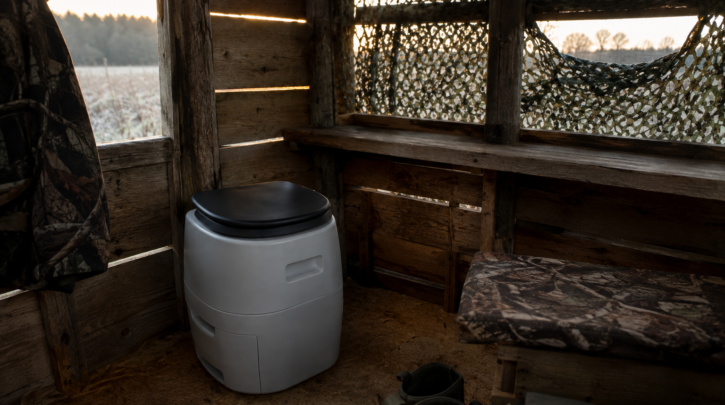

Hunting camps and blinds have specific requirements that don’t fully overlap with either van life or backyard camping content: extended unattended periods, extreme temperature swings, no reliable power in most cases, and a premium on staying quiet and low-maintenance during a hunt itself.
OGO Nomad — Purpose-Marketed for This Exact Use Case
OGO explicitly markets the Nomad for hunting blinds alongside truck campers and primitive camping, and the fit makes sense: at 9 lbs with no power, no setup tools, and a simple bag-based system that fits 8-gallon trash bags widely available at any hardware store, it’s about as low-maintenance as this category gets. There’s nothing to wire, nothing to vent, and nothing that requires attention between hunts beyond keeping a bag and some coco coir on hand.
BOXIO — Similarly Well-Suited
BOXIO is explicitly marketed for hunting alongside car camping and boating, and its compact, stackable eurobox shape stores easily in a blind or small cabin between seasons without taking up much space. Full details in our BOXIO review.
Fixed Blinds vs. Portable Setups
A permanent, fixed hunting blind with returning use season after season can reasonably justify a slightly more capable setup than a portable blind moved between locations throughout a season. For a fixed blind, consider keeping the toilet permanently on-site rather than transporting it each visit, provided secure, dry storage is available to protect it from weather and animals between hunts. For a portable blind setup that moves with the hunt, prioritize the lightest option — the OGO Nomad’s 9 lbs is a genuine advantage here — and build carrying it in and out into your normal gear routine rather than treating it as a separate trip.
Group Camps and Lease Properties
Hunting leases and club properties shared among several hunters face a different calculus than a solo blind — multiple people using one unit across an active weekend compounds capacity needs the same way group camping does, covered in more detail in our portable composting toilets guide. For a shared lease cabin with regular multi-person weekend use throughout the season, it’s worth stepping up to a higher-capacity option, or keeping two portable units on hand rather than expecting one to comfortably serve a full group of hunters through an entire weekend without more frequent attention than a solo user would need.
Setup Speed During Prime Hunting Hours
Hunters value setup speed for a specific reason that doesn’t fully apply to recreational campers: time spent setting up gear is time not spent hunting during the most productive hours around dawn and dusk. Both BOXIO and the Nomad’s sub-five-minute, tool-free setup genuinely matters here — arriving at a blind before first light and having a functional bathroom setup in a couple of minutes rather than fumbling with tools in the dark is a real practical advantage that’s easy to underrate until you’ve actually needed it during a rushed pre-dawn arrival.
Handling Extended Periods Between Visits
Hunting cabins and blinds often sit unused for weeks or months between visits, which is a genuinely different usage pattern than daily van life or even weekend camping. Before leaving a unit for an extended stretch, empty both the solids bag and liquids container fully rather than leaving material sitting for months — this matters more here than almost anywhere else on this site, since a hunting cabin might not see anyone check on it until the next season. If freezing temperatures are a realistic concern at your specific location, leave containers empty and lids slightly open rather than sealed shut, the same general principle covered in our maintenance guide‘s seasonal care section.
Temperature Extremes
Hunting season often means cold-weather use specifically, and composting slows meaningfully below roughly 55°F regardless of which unit you choose — this affects breakdown speed, not basic function, so the toilet still separates and holds waste normally through cold hunts. If your hunting property also sees genuinely hot summer use for other purposes, the same portable units handle heat without issue, though carbon additive may need slightly more frequent replenishment in humid summer conditions than in a dry, cold hunting season.
Discretion and Noise
For an active hunting blind specifically, noise and scent discretion matter in a way they don’t for a van or cabin. Both BOXIO and the Nomad are entirely passive with no fan or motor, which means zero operational noise — a genuine advantage over any fan-equipped unit in a context where staying quiet actually matters. Neither uses any chemical scent, which some hunters specifically value given how sensitive wildlife can be to unfamiliar smells near a blind.
Choosing Between OGO Nomad and BOXIO for This Use Case
Both are strong, near-interchangeable choices for a hunting camp, and the decision often comes down to small details rather than a clear winner. The Nomad’s lighter 9 lb weight matters more if you’re hauling gear a distance to a remote blind on foot; BOXIO’s slightly larger accessory ecosystem (storage riser, cushion) matters more if the unit will live semi-permanently at a fixed blind or small cabin rather than being carried in and out each trip. Either choice is a reasonable default, and the general guidance in our portable composting toilets guide and BOXIO review applies directly here.
Storage Between Hunting Seasons
Between seasons, a hunting camp toilet often sits unused for many months longer than the “extended periods between visits” scenario covered above during an active season — closer to true long-term storage than a temporary gap. Clean both containers thoroughly, let them dry completely before closing up, and store the unit somewhere rodents and other wildlife can’t access it, which is a more realistic concern at a remote hunting property than at a van or backyard shed. A few campers specifically recommend storing the solids container with the lid slightly propped rather than fully sealed for a multi-month gap, to avoid trapping any residual moisture against the plastic over an extended closure.
Who Should Consider a Larger Unit Instead
If your hunting property includes a more substantial cabin used regularly by a group rather than a solo blind, the cabin-oriented brands covered in our best composting toilets for cabins guide — particularly the non-electric Sun-Mar Excel NE — may be a better fit for higher-capacity, multi-person use than a portable unit designed for one or two people at a time.
Related Guides
Frequently Asked Questions
Will a portable composting toilet attract wildlife to a hunting blind?
Properly sealed and maintained, no more than any other equipment stored at a blind — the lack of chemical scent is actually cited by many hunters as an advantage over chemical portable toilets specifically for this reason.
Can I leave a composting toilet in an unheated blind over winter?
Yes, as long as both containers are emptied before an extended freeze — an empty unit handles cold storage fine, while one left with liquid in it risks freezing and potential damage to seals or containers.
How much capacity do I actually need for a hunting camp with multiple people?
For a group using one unit over a multi-day hunt, plan on emptying more frequently than a solo user would — an 8–10 use solids bag stretches less far with three or four people sharing it, so budget for more frequent bag changes or consider a higher-capacity option if the group and duration are large.
Is a composting toilet quiet enough for an active blind during a hunt?
Yes — the portable, non-electric options covered here have no fan or motor at all, making them silent in operation, unlike any fan-equipped self-contained unit.
Should I keep a dedicated toilet at each blind, or move one between locations?
This comes down to how many blinds you actively rotate between and your budget — a dedicated unit at each fixed blind removes the hassle of transporting one back and forth, while a single portable unit moved between locations is more economical if you’re not using multiple blinds simultaneously. Given the low cost of the portable tier covered here, keeping a dedicated unit at each frequently-used blind is a reasonable choice for most hunters rather than a significant expense.
Does a composting toilet need any special care after exposure to mud, dust, or rough handling in the field?
Both BOXIO and the Nomad are built with rugged, weather-resistant materials specifically for this kind of use, and a simple wipe-down after a muddy trip is generally all that’s needed — there’s no delicate mechanism to damage from typical field handling, which is part of their appeal for this specific use case.
Are these units legal to use on public hunting land?
Using the toilet itself is unregulated on public land the same as any personal camping gear, but disposal of solids is where local rules apply — check with the specific land management agency (state wildlife area, national forest, etc.) for their waste disposal requirements before your trip, since these vary by jurisdiction the same way general camping waste rules do.