
Every self-contained unit covered elsewhere on this site — Nature’s Head, OGO, Air Head, CompoCloset Cuddy — uses a continuous system: one chamber fills, partially composts, and gets emptied on a rolling basis. Batch and two-chamber systems work fundamentally differently, and they’re the standard approach once you’re building for a full household rather than a van, RV, or weekend cabin.
If you’ve read through our other buying guides on this site, this page will feel like a shift in scale — everything discussed here applies to a genuinely different category of installation than a self-contained unit, closer in scope to plumbing a full bathroom than to mounting an appliance.
How Batch Systems Actually Work
Instead of one chamber cycling continuously, a batch system uses two (or more) separate chambers. One fills while the toilet is in active use; the other, already full, sits completely undisturbed to finish composting without any new material being added. Once the active chamber fills, the system switches to the second chamber, and the first is left alone to fully cure. This uninterrupted curing time is the key advantage — material that’s never disturbed by fresh additions composts more completely and predictably than a continuously-topped-up chamber ever can, which is exactly why batch systems are the standard for facilities that need genuinely finished, safe compost rather than just well-managed waste holding.
This two-chamber approach is conceptually similar to a well-managed backyard compost system with two bins — one actively receiving material, one resting and finishing — just engineered and scaled for continuous indoor use rather than an open-air garden setup.
Clivus Multrum: The Reference Brand for This Category
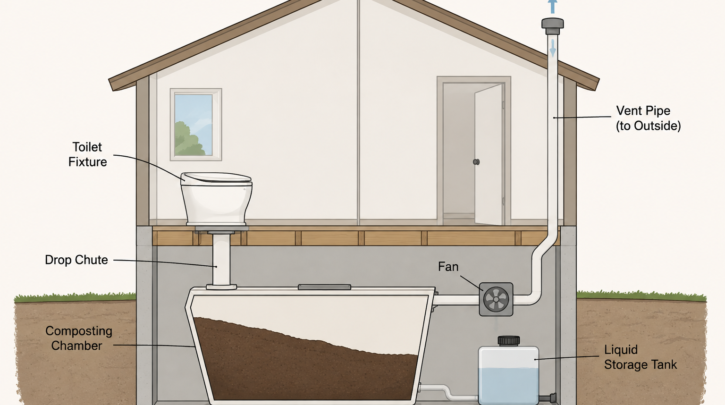
Clivus Multrum is close to synonymous with large-scale batch composting toilets, and understanding how it works explains the category well. Invented in Sweden and patented in 1962, the design was brought to the US market in 1973 by Abby Rockefeller, and the company has since sold more than 20,000 systems worldwide. The name itself — “inclined chamber” — describes the core design: a sloped composting tank where urine separates from solids automatically by gravity, flowing to the lowest point where bacterial action converts it into a stable liquid rich in nitrite and nitrate, generated at roughly one gallon per 20 uses and typically pumped automatically into a separate storage tank.
This gravity-based separation is worth appreciating as an elegant piece of design in its own right — it achieves the same core benefit that active urine-diverting bowls provide in self-contained units, just through the physical slope of the chamber rather than a mechanical diverter, with genuinely nothing to clog or misalign over decades of use.
Tank sizes range from 650 to 4,200 liters depending on the model, with residential options like the M1 (vacation/seasonal use, one toilet) scaling up through the M2, M3, M10, and M12 for full-time, multi-bathroom residences. Rated capacity spans an enormous range — from occasional seasonal use up to 18,000–65,000 uses per year per composter for higher-capacity commercial-grade models. Every system includes a fan for odor elimination, an automatic moistening system, and the liquid storage and pump-out setup described above.
The Low Profile Variant for Tiny Homes
Clivus Multrum’s Low Profile (CM LP) model deserves specific mention since it was engineered directly for a problem standard batch chambers create in tight spaces: a compost pile naturally forms a cone shape beneath the toilet, and in a chamber with limited height, that cone wastes a meaningful share of the available volume. The Low Profile design uses a wider-diameter, shorter chamber with a built-in mixer specifically to knock down that cone and redistribute material evenly, recovering roughly 30% more usable volume than a standard chamber would achieve at the same height. It’s the option to look at specifically if you’re building a tiny home or any structure with limited underfloor clearance — see our composting toilet for tiny homes guide for more on this.
How Installation Differs From a Self-Contained Unit
This is a fundamentally bigger project than mounting a self-contained toilet. The composting chamber itself sits below the toilet fixture — typically in a basement, crawlspace, or dedicated utility area — which means the toilet’s physical location is constrained by where the chamber can actually go, not the other way around. Some systems, like Clivus Multrum’s Foam-Flush fixture option, use a small amount of water (around six ounces per use) carried through a standard 4-inch drain line that can bend up to 45 degrees, which gives more flexibility in fixture placement relative to the chamber below than a pure gravity-drop design requires. Either way, this is a system best planned during new construction or a major renovation, not retrofitted into a finished space without significant work.
Pros and Cons Versus Self-Contained Units
- Far higher capacity — batch systems are built for full households and sometimes multiple toilets feeding one composter, well beyond what any self-contained unit supports
- More completely finished compost — the undisturbed curing time in an inactive chamber produces a more stable, finished product than a continuously-used chamber
- Significantly bigger installation project — requires real underfloor space and is far better suited to new construction than retrofitting
- Higher upfront cost — both the equipment and the construction work involved cost meaningfully more than any self-contained unit on this site
Who This Is Actually For
Full-time off-grid households larger than what a Sun-Mar Excel or Separett Villa comfortably handles, new-construction cabins or homes where you can plan the chamber location from the start, and any property with multiple bathrooms feeding into a shared system. If you’re building a single-bathroom cabin or weekend retreat, the self-contained and drain-based options covered in our best composting toilets for cabins guide are almost always the simpler, more cost-effective choice.
What a Realistic Budget Looks Like
Because these systems scale from small seasonal-use models to large multi-bathroom commercial-grade installs, there’s no single price figure worth quoting here the way there is for a self-contained unit — the equipment cost alone varies enormously by tank size and model tier, and that’s before adding the construction cost of the chamber space itself, any Foam-Flush plumbing, and professional installation labor if your jurisdiction requires it. Get a direct quote from the manufacturer or an authorized dealer once you know your household size and rough chamber location, rather than trying to estimate from a self-contained unit’s pricing — the two categories aren’t really comparable on cost.
Permitting Considerations
Batch and central composting systems fall under the same general permitting framework covered in our legal requirements and permits by state guide — reviewed as Onsite Wastewater Treatment Systems alongside septic installations, generally requiring NSF/ANSI 41 certification. Given the scale and permanence of these installations, it’s worth involving your local health department early in the design process rather than after construction has started, since a chamber location that doesn’t pass review could mean significant rework.
Other Batch System Manufacturers
Clivus Multrum is the reference brand for this category, but it’s not the only one — Sun-Mar’s Centrex line, mentioned briefly in our cabin buying guide, offers a similar central-system approach at a different price and capacity point, and several regional and specialty manufacturers build custom or semi-custom batch systems for specific site conditions. If you’re comparing options beyond Clivus Multrum specifically, the core evaluation criteria stay the same regardless of brand: rated capacity against your actual household size, required underfloor clearance against what your specific site offers, and NSF/ANSI 41 certification status for permitting purposes.
Related Guides
- Best composting toilets for cabins
- Composting toilet for tiny homes
- Legal requirements/permits by state
Frequently Asked Questions
Can a batch system serve more than one bathroom?
Yes — larger Clivus Multrum models like the M3, M10, and M12 are specifically designed to accept two or more toilet fixtures feeding into the same composting chamber, which is common in larger residences or facilities with multiple bathrooms.
How much underfloor clearance does a batch system actually need?
This varies by model — Clivus Multrum’s High Profile system needs roughly 750mm (about 2.5 feet) of underfloor clearance, while the Low Profile variant was engineered specifically for tighter spaces like tiny homes with less room to work with.
Is a batch system more maintenance, or less, than a self-contained unit?
Generally less frequent hands-on maintenance per use, since the large chamber size and automated moistening and liquid removal systems reduce how often you’re physically interacting with the system compared to emptying a self-contained unit’s bins every few weeks — though when maintenance is needed, it’s a bigger task than swapping a small bin.
Can I add a second composting chamber to increase capacity later?
Some systems support this, but it depends heavily on your specific model and whether your original installation left room and plumbing access for expansion. This is worth discussing directly with the manufacturer or an installer during your initial planning if there’s a reasonable chance you’ll need more capacity down the line.
How does a batch system handle a household that travels or is away for extended periods?
Generally well — since the chamber isn’t dependent on continuous fresh input the way a septic system’s biological balance can be affected by disuse, an inactive batch chamber simply continues curing undisturbed during any absence, which if anything benefits the composting process rather than causing problems.