
Tiny homes sit in an odd middle ground between our van/RV content and our cabin content — often built on a foundation like a small house, but just as often built on a trailer and moved like an RV. Which category your specific tiny home falls into changes both which toilet makes sense and which rules actually apply to you.
This guide points you to the more detailed content elsewhere on this site for each specific model, rather than repeating full specs here — its job is to help you figure out which category of solution actually fits your specific build before you go comparing individual products.
Tiny Home on Wheels vs. Tiny Home on a Foundation
This distinction matters more than almost anything else in this guide. A tiny home on wheels (often shortened to THOW) is frequently treated similarly to an RV for code and legal purposes in the US, though this varies by state and even by county — some jurisdictions have specific tiny-home-on-wheels provisions, others default to RV classification, and others have no clear answer at all yet. A tiny home built on a permanent foundation, by contrast, is generally treated as a small residential structure subject to standard residential building and plumbing codes, much closer to the cabin content covered elsewhere on this site. Confirm which category your specific structure falls into with your local building authority before assuming either path — this single classification question determines most of your other answers.
It’s worth asking this question even if you’re confident you already know the answer, since tiny-home-specific code is a genuinely fast-evolving area in many states, and a classification that applied when a neighbor built their tiny home a few years ago may not reflect current rules in your jurisdiction today.
Space and Weight Constraints
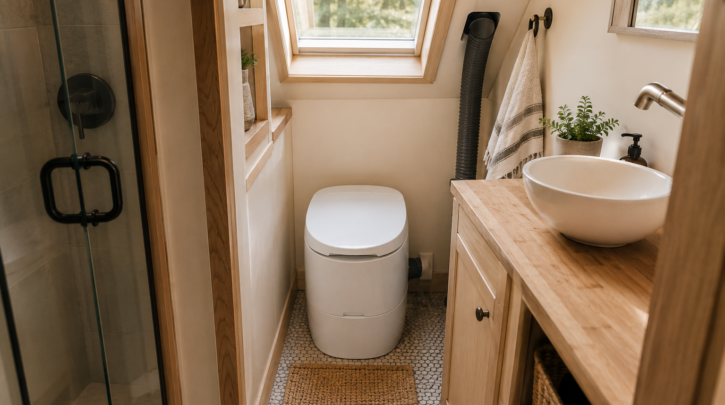
Tiny homes on wheels face the same weight and footprint pressures covered in our van life buying guide, often more acutely — a trailer’s axle rating is a hard limit the way a van’s payload capacity is, and every pound of toilet, water, and building materials competes for that same budget. Compact self-contained units like the OGO Origin or CompoCloset Cuddy, covered in our small/compact composting toilets guide, are frequently the right fit here for exactly the reasons they work well in a van. Foundation-built tiny homes have more flexibility, closer to a small cabin’s constraints than a vehicle’s, which opens up options like the Separett Villa or even a scaled-down batch system if the structure’s crawlspace or basement allows for it.
Measure twice here specifically — tiny home builders consistently report that toilet and bathroom space is one of the areas most likely to get squeezed during a build as other priorities compete for limited square footage, and a compromise made early in planning can be hard to revisit once framing is underway.
The Clivus Multrum Low Profile Option
For foundation-built tiny homes specifically, the Clivus Multrum Low Profile deserves a specific look — it was engineered directly for the limited underfloor clearance a tiny home’s compact footprint typically has, using a wider, shorter chamber with a built-in mixer to overcome the volume loss that a standard batch chamber’s cone-shaped pile would otherwise cause in a low-clearance space. Full details on how this design works are covered in our two-chamber and batch systems guide. It’s actually one of the few batch-style options genuinely designed to fit beneath a tiny home trailer’s low clearance, not just foundation-built structures — worth a look for a wheeled build if a self-contained unit’s smaller capacity isn’t enough for your household size.
Ventilation in a Very Small Space
Tiny homes amplify every ventilation consideration covered in our general venting and ventilation guide, simply because there’s so little air volume in the space to begin with — a minor odor issue that would be barely noticeable in a full-size cabin becomes much more apparent in 200 square feet or less. This makes proper vent routing and a working fan even more important than in a larger structure, and it’s worth being especially diligent about the prevention checklist in our odor guide given how little margin for error a tiny home’s air volume provides.
Legal and Permitting Considerations
If your tiny home is classified as an RV or vehicle, composting toilet installation is typically unregulated the same way it is in any van or RV build. If it’s classified as a permanent residential structure, you’re in the same territory covered in our legal requirements and permits by state guide — NSF/ANSI 41 certification, OWTS-style permitting, and local health department review. Given how genuinely unsettled tiny-home-specific building code is in many jurisdictions, this is an area worth a direct conversation with your local building authority rather than assuming either path applies by default.
Water and Greywater Considerations Unique to Tiny Homes
A composting toilet’s water-saving benefit matters disproportionately in a tiny home, where onboard freshwater tank capacity is often measured in tens of gallons rather than the hundreds a standard home’s plumbing assumes. Eliminating toilet flushing specifically stretches that limited water supply meaningfully further between refills, which is part of why composting toilets have become close to a default choice in the tiny home movement rather than a niche alternative. Greywater from a tiny home’s sink and shower still needs handling regardless of toilet choice — for a wheeled structure, this is usually a small holding tank managed like an RV’s greywater tank; for a foundation-built tiny home, it typically falls under the same wastewater rules as any small residential structure, covered more generally in our legal requirements guide.
Resale and Financing Considerations
Tiny homes already occupy an unusual space in the real estate and financing world, and a composting toilet adds one more factor for a future buyer or lender to evaluate. Traditional mortgage lenders are often unfamiliar with tiny homes generally, and a non-standard sanitation system can be one more point of friction in an already atypical financing conversation — worth discussing directly with a lender familiar with tiny home financing specifically if resale or financing flexibility matters to your situation. For tiny homes intended as a personal project without near-term resale plans, this is a much smaller consideration, and the practical day-to-day and water-saving benefits generally outweigh it.
Choosing by Tiny Home Type
- Tiny home on wheels, tight budget: CompoCloset Cuddy or Cuddy Lite
- Tiny home on wheels, want proven reliability: Nature’s Head
- Foundation-built, want to avoid a bottle-emptying routine: Separett Villa
- Limited underfloor clearance (wheeled or foundation-built), want the highest capacity: Clivus Multrum Low Profile
Insulation and Climate Control in a Tiny Footprint
A tiny home’s small total volume means temperature swings happen faster than in a larger structure, which affects the composting process more noticeably than it would in a full-size cabin. Aerobic bacterial activity slows meaningfully below roughly 55°F, and a tiny home with minimal insulation or a large amount of exterior wall relative to its floor space can swing through that threshold more often across a typical day-night cycle in cooler climates. This isn’t a dealbreaker — it mainly affects composting speed rather than basic function — but it’s worth factoring into your expectations if you’re in a cold climate and want more consistent, faster breakdown rather than accepting a slower pace through cooler months.
Related Guides
- Small/compact composting toilets for tight spaces
- Two-chamber and batch composting toilet systems
- Legal requirements/permits by state
Frequently Asked Questions
Is a tiny home on wheels legally treated as an RV?
Often, but this genuinely varies by state and county, and some jurisdictions have specific tiny-home provisions rather than defaulting to RV classification. Confirm this directly with your local building authority — it changes which composting toilet rules actually apply to you.
Can I install a batch system in a tiny home on wheels?
Generally not practically — batch systems need real underfloor space that a trailer-based structure doesn’t have, and the weight of a full composting chamber would likely exceed reasonable limits for a towable structure. Self-contained units are the realistic option for wheeled tiny homes.
How does moving a tiny home on wheels affect a composting toilet?
Empty both the solids and liquids containers before any significant move, the same way you would before extended van or RV travel — a partially full chamber sloshing around during transit is both messier and more likely to compromise the urine diversion seal than a properly emptied one.
Do tiny homes need a bigger toilet than a van, given more people might live there full-time?
Not necessarily based on square footage alone — capacity should be sized to number of occupants and how full-time your use is, the same considerations covered in our general buying guides, rather than assumed from the structure’s size or category.