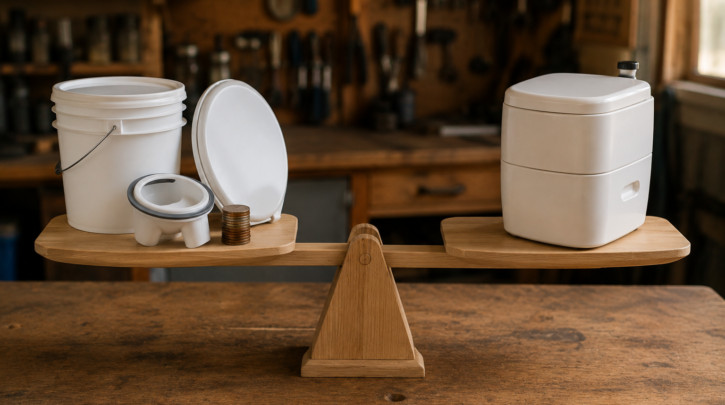

The dollar gap between DIY and buying is real, but it’s not the whole picture. Time, risk, capacity, and support all factor into which option actually makes sense for your situation — here’s the full comparison.
We’ve referenced pieces of this comparison throughout our DIY content, but this page pulls everything together in one place — the numbers, the honest tradeoffs, and a clear framework for deciding which path actually fits your specific situation rather than just following whichever choice sounds more appealing in the abstract.
Upfront Cost Comparison
Laying every option side by side makes the actual scale of the price gap clear — this isn’t a marginal difference between the cheapest and most expensive paths, it’s closer to a 40x spread from the absolute lowest DIY tier to a premium manufactured unit. Understanding where you land on this spectrum, and why, is the key to making a genuinely informed choice rather than defaulting to whichever option you happened to see mentioned first.
| Option | Approx. Cost | Capacity | Warranty |
|---|---|---|---|
| DIY Tier 1 (homemade diverter) | $30–60 | Single bucket, ~5 gallons solids | None |
| DIY Tier 2 (purchased diverter + vent) | $100–250 | Single bucket, ~5 gallons solids | None (except on the purchased diverter itself, if any) |
| Cheapest manufactured (BOXIO, Nomad) | $180–300 | 8–10 uses per bag cycle | Up to 3 years (OGO Nomad) |
| Mid-tier manufactured (CompoCloset Cuddy) | $650–850 | 2–3 weeks for two people | 2 years |
| Premium manufactured (Nature’s Head, Separett) | $960–1,300+ | 60–80 uses / 6-gallon container | 5 years |
What DIY Actually Saves You
At the extreme, DIY Tier 1 costs roughly 5% of a premium manufactured unit’s price. Even a well-equipped DIY Tier 2 build with a purchased diverter and vent kit lands at 15–25% of a premium unit’s cost. This gap is real money, particularly meaningful for anyone on a genuinely tight budget or simply testing whether composting toilets fit their lifestyle before committing more.
That savings compounds if you’re outfitting more than one bathroom — a second van, a guest cabin, or a backup unit for a shared property. The price gap between DIY and manufactured stays proportionally the same whether you’re buying one or several, so a multi-unit project sees the DIY savings multiply directly rather than shrinking with scale the way some bulk manufactured purchases might.
What DIY Actually Costs You Beyond Dollars
These costs don’t show up on a price tag, which is exactly why they’re easy to underweight when comparing options purely by dollar amount. Weigh them honestly against the savings before assuming DIY is automatically the smarter financial choice.
- Your own time — anywhere from an hour to a full weekend depending on build complexity, plus ongoing troubleshooting time if something doesn’t work perfectly on the first attempt
- No manufacturer support — you’re your own troubleshooter, without a customer service line to call if something goes wrong
- Smaller typical capacity — a single bucket holds meaningfully less than most manufactured solids bins, meaning more frequent emptying unless you build in multi-bucket rotation
- Less polished result — even a well-executed DIY build generally looks and feels more utilitarian than a manufactured product
The Real Break-Even Point
For most people, the practical comparison isn’t DIY versus a premium $1,000+ unit — it’s DIY versus the cheapest manufactured tier covered in our budget composting toilets guide. Once you factor in build time, the risk of a first-attempt diverter not fitting quite right, and the lack of warranty, a $180–$230 BOXIO closes most of the practical gap against a well-equipped DIY Tier 2 build, while removing nearly all of the assembly effort and risk. The dollar savings from DIY only become clearly worth it at Tier 1, where the cost gap is largest and the effort is smallest.
This is worth sitting with honestly before committing to a full DIY build: if your realistic destination is a $150–$200 DIY Tier 2 setup, you’re only saving $50–100 over a warrantied, tested manufactured alternative in exchange for a weekend of build time and the risk of first-attempt fitting issues. The math only strongly favors DIY when you’re comparing against Tier 1’s minimal-cost approach, or when the building process itself is something you value rather than just tolerate.
Five-Year Ownership Cost
Ongoing costs — carbon additive, replacement bags, occasional part replacement — are broadly similar across DIY and manufactured options at comparable capacity, since the underlying consumables are the same regardless of who made the housing around them. Over five years of moderate use, ongoing costs typically run $150–$400 for either path, meaning the upfront price gap between DIY and manufactured remains the dominant factor in total cost of ownership rather than narrowing significantly over time.
Resale Value Considerations
A manufactured unit holds resale value in a way a DIY build simply doesn’t — Nature’s Head, Separett, and other established brands maintain a genuine secondhand market, since a used premium unit still carries real functional value and brand recognition to a buyer researching the category. A DIY build has essentially no resale market of its own; at most, you might sell the individual components (buckets, a purchased diverter) rather than the assembled unit as a package. If you think there’s a real chance you’ll want to recoup some cost by selling later — moving out of van life, upgrading your setup — factor this into the DIY-versus-buying decision, since it’s a real, if often overlooked, part of the true cost comparison.
When DIY Is Clearly the Right Call
- Your budget genuinely can’t stretch to even the cheapest manufactured option right now
- You want to test the composting toilet concept before investing more
- You enjoy building things and see the process itself as part of the value
Any one of these on its own is a reasonable justification for choosing DIY — you don’t need all three to apply before it makes sense for your situation.
When Buying Is Clearly the Right Call
- You want a warranty and manufacturer support if something goes wrong
- You’d rather not spend a weekend building and troubleshooting
- You need higher capacity than a single-bucket DIY setup comfortably provides
Related Guides
- Cheapest way to start a composting toilet
- Best budget composting toilets under $300
- 5-gallon bucket composting toilet guide
Frequently Asked Questions
Is a DIY build actually less reliable than a manufactured one?
Not inherently — a well-built DIY unit using a purchased diverter and following proper carbon additive and ventilation practices performs comparably on the fundamentals. The reliability gap is more about troubleshooting support and build quality consistency than the underlying technology itself.
Does DIY make more sense for a van than a cabin, or vice versa?
DIY tends to make more sense for a van or occasional-use setup where the smaller single-bucket capacity is less of a limitation. A full-time cabin household generally outgrows a single-bucket DIY setup faster, making a manufactured unit’s larger capacity more valuable there.
Can I sell or repurpose DIY parts if I later switch to a manufactured unit?
Buckets and basic hardware have general resale or repurposing value, though a purchased diverter is unit-specific enough that resale demand is limited — factor this into your decision if you think there’s a real chance you’ll upgrade within a year or two.
Is there a hybrid option between full DIY and full manufactured?
Yes — CompoCloset’s Cuddy Lite, covered in our van life and budget guides, is essentially a manufactured take on the bag-based DIY approach, offering a middle price point with manufacturer support but without a full agitator mechanism.
Which option is better if I’m not sure I’ll stick with van life or off-grid living long-term?
DIY Tier 1 or 2 makes the most sense here specifically because the low upfront investment limits your downside if your lifestyle changes — you’re not out much money if you end up not needing a composting toilet after all, compared to a $650+ manufactured unit you might struggle to recoup value on if your plans shift.
Is it common to start with DIY and later switch to a manufactured unit?
Yes, this is a genuinely common path — start cheap to confirm the composting toilet concept fits your lifestyle, then upgrade to a manufactured unit once you’re confident in the investment. Most of your DIY-phase learning about carbon additive habits and emptying routines carries over directly, making the eventual manufactured unit feel familiar rather than like starting over.
Does the comparison change for a permanent cabin install versus a van or camping setup?
Somewhat — a permanent cabin installation favors manufactured units more strongly, since higher-capacity cabin-oriented brands like Sun-Mar don’t have a comparable DIY equivalent, and a fixed installation’s larger scope makes professional-grade reliability more valuable than in a smaller, more forgiving van or camping context.