
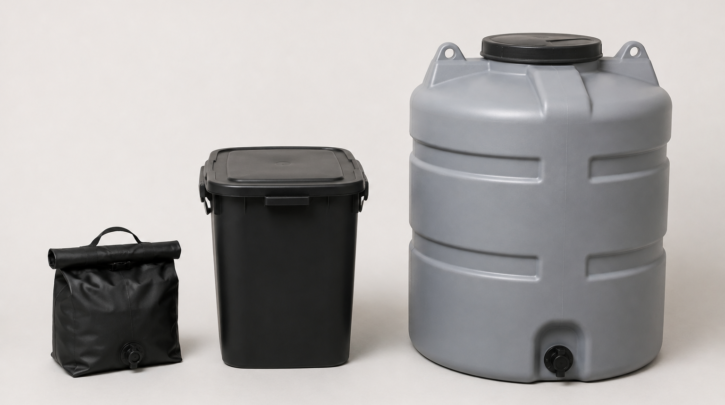

Capacity is the single most important spec after footprint, and it’s the one most likely to catch new buyers off guard — a unit that “should” last a couple’s whole week often means something different in practice than the marketing suggests. Here’s every model’s real capacity, side by side.
We’ve split this into solids and liquids separately, since they behave quite differently in practice — liquids fill faster and drive your day-to-day routine, while solids capacity determines your longer-cycle maintenance rhythm.
Solids Capacity by Model
Figures below reflect manufacturer specifications and independent reviewer testing where available, cross-referenced against the individual model reviews elsewhere on this site.
| Model | Solids Capacity | Typical Emptying Frequency (1–2 people) |
|---|---|---|
| OGO Nomad / BOXIO | 8–10 uses per bag | Every few days to a week |
| OGO Origin | 25–30 uses | Every 3–4 weeks |
| CompoCloset Cuddy | 2–3 weeks (2 people, full-time) | Every 2–3 weeks |
| Nature’s Head | 60–80 uses | Every 3–6 weeks |
| Air Head | Up to 80 uses (5-gal tank) | Every 3–6 weeks |
| Separett Villa | 6-gallon container | Varies with household size |
| Sun-Mar Excel | 3 adults residential / 6–8 weekend | Weeks to over a month depending on use |
| Clivus Multrum | 18,000–65,000 uses/year (larger models) | Months between service, by design |
Notice the enormous range here — a factor of nearly 1,000x between the smallest portable option and the largest batch system. This isn’t a flaw in any single design; it reflects genuinely different use cases, from occasional weekend camping to a full household’s daily sanitation needs.
Liquids Capacity by Model
| Model | Urine Container Size | Typical Emptying Frequency |
|---|---|---|
| OGO Nomad | ~1.2 gallons | Every 1–2 days |
| CompoCloset Cuddy | 1.7 gallons | Every 1–2 days (2 people) |
| Nature’s Head | 2.2 gallons | Every 1–3 days |
| OGO Origin | 2.4 gallons | Every 1–3 days |
| Air Head | 3L or 7L options | Every 1–3 days depending on tank chosen |
| Separett Villa | No onboard container — external drain | N/A — continuous drain, not stored |
Notice the pattern here: liquids capacity varies far less dramatically across models than solids capacity does, since urine containers are constrained by practical handling weight (a full container needs to still be liftable and pourable) more than by chamber engineering. This is part of why liquids emptying frequency ends up surprisingly similar across very different price tiers — a $180 BOXIO and a $1,000 Nature’s Head both need daily-ish attention on the liquids side, even though their solids capacity differs enormously.
Why Marketing Numbers and Real-World Numbers Diverge
A capacity rating like Sun-Mar’s “6–8 people weekend use” describes maximum rated performance, not comfortable, low-maintenance daily operation. In practice, capacity ratings hold up well for exactly the usage pattern they’re designed around — occasional heavy weekend use — but degrade toward the lower, more conservative end of the range for continuous full-time use. If you’re living in your rig or cabin full-time rather than visiting occasionally, plan around the lower number in any range, not the headline maximum.
This gap between rated and real-world capacity is also why the “number of uses” figures published by different manufacturers aren’t always perfectly comparable to each other — testing methodology and what counts as a single “use” can vary slightly between brands. Treat these figures as useful relative guidance for comparing options rather than precise, interchangeable predictions of your own exact experience.
How Carbon Additive Choice Affects Capacity
Your choice of carbon additive genuinely affects how much usable capacity you get from a given chamber size, since more absorbent, better-structured material (coco coir specifically) makes more efficient use of available space than a material prone to compacting, like peat moss over time. See our full carbon additive comparison — this is a free way to stretch a unit’s effective capacity without buying a larger model.
This is worth remembering before assuming you need to upgrade to a larger, more expensive unit if you’re finding your current capacity tight — sometimes a simple switch in carbon additive closes most of the gap for a fraction of the cost of a new toilet entirely.
Sizing for Your Household
Putting the tables above into practical recommendations by household type and usage pattern:
- Solo, occasional use: Any portable tier option comfortably covers this
- Solo or couple, full-time van/RV: Nature’s Head, Air Head, or OGO Origin for solids margin; budget for daily-to-every-few-days liquids emptying regardless of model
- Couple, full-time cabin: Separett Villa or Sun-Mar Excel
- Family, full-time off-grid home: Sun-Mar Excel at minimum; consider a Clivus Multrum batch system for genuinely sustained multi-person daily use
Planning for Guests and Occasional Overflow
If your household size fluctuates — visiting family, occasional guests staying over — plan around your realistic peak usage rather than only your typical day-to-day number. A unit sized precisely for solo use will feel noticeably strained during even a short visit from a second person, since capacity math doesn’t scale gently; two people can fill a liquids container in half the time one person would, not gradually more but genuinely twice as fast. If guest visits are a regular part of your situation, sizing one tier up from your baseline solo or couple needs avoids this recurring strain.
Related Guides
- Maintenance & emptying guide
- Composting toilet size chart
- Two-chamber and batch composting toilet systems
Frequently Asked Questions
Which matters more for capacity planning — solids or liquids?
Liquids, in practice — the solids container’s longer interval between empties means it rarely dictates your actual routine, while the smaller, more frequently filled liquids container is what most owners report managing day to day.
Does capacity decrease over the life of the unit?
No — the physical chamber size doesn’t change with age. What can change is effective capacity if seals degrade or an agitator motor weakens, both addressed through the routine maintenance covered in our general maintenance guide.
Can I increase a unit’s capacity after buying it?
Not meaningfully for most self-contained units, since chamber size is fixed by design. CompoCloset’s Cuddy/Cuddy Lite modular line is a partial exception, and switching to a more absorbent carbon additive can stretch effective capacity somewhat regardless of model.
Is it better to size up “just in case,” or match capacity closely to current needs?
If there’s a reasonable chance your household will grow, sizing up modestly avoids an expensive early upgrade. For a stable, known usage pattern, matching capacity closely avoids paying for space and features you won’t use.
How does capacity change with the season or climate?
Capacity itself (the physical chamber size) doesn’t change, but how quickly you fill it can — hot, humid conditions sometimes mean slightly more carbon additive use per session, which modestly reduces effective capacity between empties compared to a dry, temperate climate.
Do guests visiting for a weekend meaningfully affect my emptying schedule?
Yes, more than people expect — an extra person for even a few days accelerates both liquids and solids filling noticeably. If you host regularly, plan your typical emptying schedule with some buffer rather than timing it right at the edge of your unit’s rated capacity.
Is there a way to check my remaining capacity without opening the unit?
Some models, like OGO Origin, include a liquid-level sensor with an indicator light for the urine container specifically. Solids capacity generally isn’t instrumented this way across any brand covered on this site — most owners track it by use count or elapsed time rather than a direct gauge.
Does adding a second person double how often I need to empty the unit?
Roughly, though not always exactly — liquids capacity tends to scale close to proportionally with users, while solids capacity sometimes stretches a bit further per person than a simple doubling would suggest, since not every use produces solid waste. Plan around the liquids side scaling directly, since that’s the more predictable and binding constraint in practice.
Are capacity figures the same for a first-time user as an experienced one?
Largely yes, though experienced users tend to use carbon additive more efficiently once they’ve dialed in the right amount per use, which can modestly stretch effective solids capacity compared to a first-time user who may over- or under-apply additive while still learning their unit’s needs.
Do the capacity figures on this page assume ideal conditions, or realistic ones?
We’ve aimed for realistic, moderate-use figures throughout rather than best-case laboratory numbers, cross-referenced against the individual reviews and owner reports covered elsewhere on this site. Your specific results will still vary somewhat based on your carbon additive choice, climate, and exact usage pattern.
Will upgrading my carbon additive alone solve a capacity problem, or do I need a bigger unit?
A better additive genuinely helps but has limits — it can meaningfully stretch the margin between empties, but it can’t overcome a chamber that’s fundamentally too small for your household’s daily volume. If you’re emptying multiple times a week despite good additive habits, that’s a sign to look at capacity guides for a larger model rather than continuing to optimize additive choice alone.