
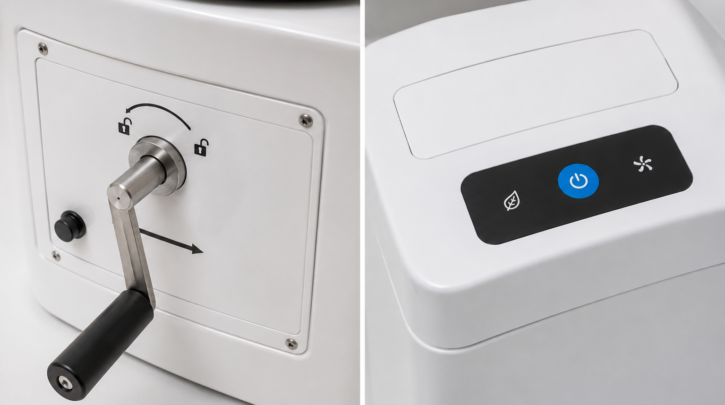

“Electric” isn’t one single thing in this category — a unit’s fan, its agitator, and any heater are three separate power draws that different models mix and match differently. Understanding exactly what power is doing in each design makes this decision much clearer.
This page breaks each of those three functions apart individually, then maps every model covered on this site to its specific power profile, so you can match your own power situation to a model precisely rather than treating “electric” as a single yes-or-no filter.
The Three Things Power Can Do
- Ventilation (fan): the most common use of power, present on nearly every model except the most bare-bones portable options. Draws very little — typically under 2 amps at 12V.
- Agitation (mixing): only on electric-agitator models like OGO Origin, replacing a hand crank with a push-button motor.
- Heating: only on some cabin-scale models like the standard Sun-Mar Excel, actively speeding composting and moisture management — a meaningfully larger power draw (roughly 125W average) than a fan alone.
Fully Non-Electric Options
BOXIO and the OGO Nomad need zero power of any kind — no fan, no agitator, relying entirely on urine diversion, carbon additive, and a tight-fitting lid for odor control. Sun-Mar’s Excel NE variant is the highest-capacity fully non-electric option covered on this site, using passive convection through a 4″ vent rather than a powered fan, with an optional low-draw 12V fan available but not required.
This category is worth strong consideration for anyone building off-grid without a reliable power source at all, or anyone who simply doesn’t want their bathroom fixture dependent on their electrical system functioning correctly. The tradeoff, covered in more detail throughout this site, is that odor control leans more heavily on manual discipline — consistent carbon additive and a properly sealed lid — without a fan actively pulling air through the chamber to help.
Fan-Only (Low Power)
Nature’s Head, standard Air Head, CompoCloset Cuddy, and the standard Separett Villa all use power exclusively for ventilation — a genuinely trivial draw that even a modest solar setup handles easily. Nature’s Head’s hand-crank agitator specifically means the only electrical dependency in the entire unit is the fan, which is why it’s often recommended as the safest choice for anyone worried about power reliability.
This category represents the most common power profile across the brands covered on this site, and for good reason — it captures nearly all of active ventilation’s odor-control benefit while adding almost nothing to a power budget. If you’re unsure which category fits your situation, this fan-only tier is the safe default most buyers land on.
Electric Agitator
OGO Origin is the standout example — its push-button motor replaces hand-cranking entirely, at the cost of a mechanical failure point that hand-crank designs simply don’t have. Covered in detail in our OGO Compost Toilet review, including the 12–18 month motor reliability pattern some heavy-use owners report.
For owners with grip strength or mobility limitations, this convenience genuinely matters beyond mere preference — a push-button mechanism removes a physical barrier that hand-cranking presents for some users. Weigh this real accessibility benefit against the added mechanical dependency when deciding whether an electric-agitator design is worth the tradeoff for your specific situation.
Electric Heating
Heating is the least common power function across models covered on this site, appearing meaningfully only in Sun-Mar’s standard Excel line — worth understanding clearly since it’s a genuinely different category of power draw than a fan or agitator.
The standard Sun-Mar Excel’s heating element actively speeds composting and manages moisture more aggressively than passive systems, at the cost of the highest power draw of any model covered on this site — a genuinely meaningful load for a solar setup, requiring more careful power budget planning than any fan-only or agitator-only design.
This is exactly the tradeoff the Excel NE variant exists to solve — same base design, same capacity rating, but without the heater, trading some composting speed for genuine power independence. If you’re deciding between the two, the honest question is whether your specific power situation can comfortably absorb a continuous ~125-watt load; if there’s real doubt, the NE variant removes that uncertainty entirely rather than leaving you managing a tight power budget around a heater.
Choosing Based on Your Power Situation
- No reliable power at all: BOXIO, OGO Nomad, or Sun-Mar Excel NE
- Modest solar/battery setup: Nature’s Head, Air Head, CompoCloset Cuddy, or Separett Villa — all trivial fan-only loads
- Reliable grid or robust solar: any model, including electric-agitator or heated options
- Want zero mechanical failure risk: avoid electric-agitator designs; hand-crank or bag-based models have no motor to fail
What You Gain and Lose With Each Approach
More electrical dependency generally buys convenience — push-button mixing instead of hand-cranking, active heating instead of passive composting — at the cost of more that can fail and more power that needs to be budgeted for. Less electrical dependency buys reliability and simplicity at the cost of some daily convenience and, for heating specifically, slower composting in cold conditions. Neither approach is objectively better; the right choice depends entirely on how reliable and generous your specific power situation actually is, not on convenience alone.
A Simple Decision Framework
If you’re still unsure which category fits your situation, ask yourself one question: if my power system failed completely for a week, would I be comfortable with my toilet still functioning at reduced performance, or would I need it fully operational regardless? If the answer is “I need it fully functional regardless,” lean toward a fan-only or fully non-electric design. If a temporary reduction in odor control during a rare power outage is an acceptable tradeoff for the convenience of an electric-agitator or heated design the rest of the time, those options are worth the added dependency.
Most owners find the fan-only middle tier answers this question comfortably for them — enough power dependency to get meaningfully better odor control than a fully passive design, without the added mechanical risk of an agitator motor or the substantial power draw of active heating.
Related Guides
- Best composting toilets for off-grid homes
- Composting toilet venting/ventilation for vans
- OGO Compost Toilet review
Frequently Asked Questions
Does a fan-only unit stop working entirely without power?
No — the core mechanism (urine diversion, hand-crank mixing) continues functioning normally. You lose active ventilation specifically, which affects odor control and composting speed but doesn’t stop the toilet from being usable.
Can I add a fan to a fully non-electric unit later?
Sun-Mar’s Excel NE explicitly supports an optional 12V fan add-on. For BOXIO and the OGO Nomad, this isn’t a standard supported modification, since these units weren’t designed with a vent hose connection point at all.
Is an electric-agitator unit worth the mechanical risk for the convenience?
This is a genuinely personal tradeoff — for many owners the convenience is worth it, particularly those with grip or mobility limitations that make hand-cranking difficult. For anyone prioritizing absolute reliability, especially for remote travel, a hand-crank design removes that risk entirely.
How much solar capacity do I need for the highest-draw option, Sun-Mar Excel?
Budget for its roughly 125-watt average draw as a genuine, continuous load in your overall system sizing — this is meaningfully more than a fan-only unit and worth discussing with an off-grid power professional if you’re designing a system from scratch around it.
Does a fan draw more power when it’s actively venting versus idle?
Most composting toilet fans run continuously at a low, steady draw rather than cycling on and off based on active use, so there’s minimal difference between “idle” and “active” power consumption — the rated draw figures across this site already reflect that continuous operation.
Can I run a fan-only unit off a small portable power station instead of a full solar setup?
Yes — the low draw of a fan-only design means even a modest portable power station can run one for extended periods, making this a realistic option for a simple setup without committing to a full solar and battery installation.
Do any manufacturers publish exact amp-hour consumption figures?
Some do, particularly for fan-only designs where the figure is small and easy to state clearly — Nature’s Head, for instance, publishes a specific 24-hour amp draw for its fan. Check your specific model’s current spec sheet for the precise number rather than relying on a general category estimate if you’re doing detailed power system planning.
If I’m building a new solar system from scratch, which power profile should I design around?
Design around a fan-only unit’s trivial draw unless you already know you want an electric-agitator or heated model — it’s much easier to size a system generously for a small load than to retrofit more capacity later if you decide to upgrade to a higher-draw unit after your power system is already built.